
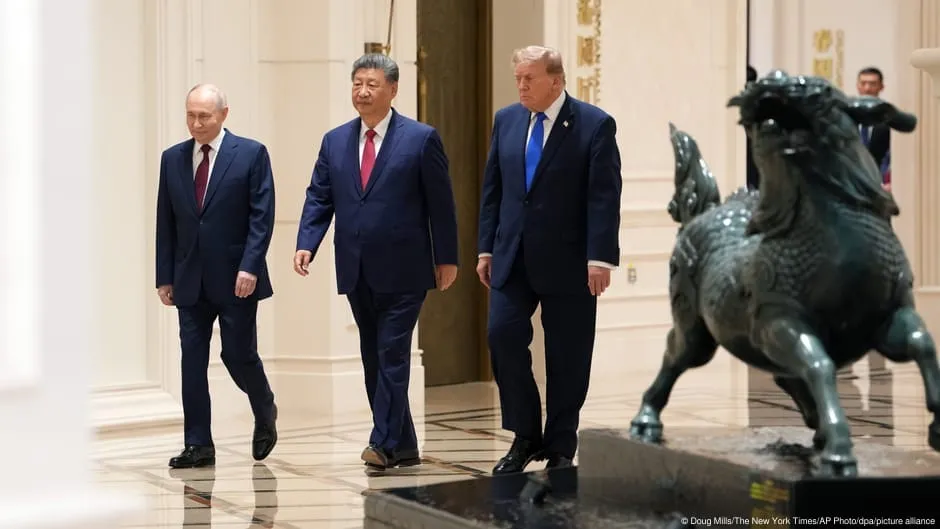
Xi-Trump-Putin trilateral summit: What was achieved in Shenzhen?
The Xi-Trump-Putin trilateral summit held in Shenzhen on November 19, 2026, brought together the leaders of China, the United States, and Russia to discuss global governance and nuclear security. While the leaders issued a 'peace declaration' reaffirming commitments to avoid nuclear war and reforming the United Nations, the document notably omitted any mention of the Russian invasion of Ukraine or the US-led conflict in Iran. The meeting aimed to address energy security and international stability, though it stopped short of establishing binding nuclear arms reductions.
November 22, 2026
4 min read
Source: ASHENVOW
The scope of the Shenzhen peace declaration
The trilateral summit in Shenzhen resulted in a joint 'peace declaration' that focused on structural international reforms rather than active regional conflicts. According to the summit's official release, the three leaders agreed to pursue reforms within the United Nations and discussed limiting the role of the International Criminal Court. The declaration also included a pledge to increase the supply of refined petroleum products to mitigate global energy challenges.
Despite the high-level nature of the talks, the document conspicuously avoided the two most pressing geopolitical crises of the era. There was no mention of the ongoing war in Ukraine or the US-led military involvement in Iran. This omission suggests a strategic choice by the participants to focus on long-term systemic issues rather than immediate escalations that might have required specific, contentious commitments.
Key themes of the trilateral agreement
- UN Reform: A commitment to restructuring global governance frameworks.
- Judicial Limits: Discussions regarding the scope and influence of the International Criminal Court.
- Energy Security: Pledges to stabilize the supply of refined petroleum products.
- Nuclear Stability: A reaffirmation of the goal to avoid nuclear conflict.
Geopolitical gains for the Russian presidency
For Vladimir Putin, the summit served as a significant platform to challenge the diplomatic isolation imposed by Western nations following the February 2022 invasion of Ukraine. By sitting alongside the leaders of the world's two other dominant military powers, Putin demonstrated his continued relevance on the global stage.
Emma Chanlett-Avery, senior director for Political-Security Affairs at the Asia Society Policy Institute (ASPI), stated that Putin had the most to gain from the meeting because "he appeared on the world stage as one of the dominant players in the world." This sentiment was mirrored in Russian domestic media, which framed the meeting as a validation of Russia's international standing.
Chim Lee, a senior analyst with The Economist Intelligence Unit (EIU), told DW that the meeting represents a "major outcome for Russia," noting that the summit effectively reinforced Moscow's position despite ongoing Western sanctions and diplomatic pressure.
Nuclear arms control and the Chinese position
The summit addressed the growing risks of nuclear proliferation, particularly following the expiration of the New START pact between Russia and the United States in February. While Donald Trump has expressed a desire for a "new, improved and modernized" agreement that incorporates China, Beijing remains hesitant to enter into similar restrictive frameworks.
The disparity in nuclear capabilities remains a primary obstacle to trilateral arms control. The following table illustrates the estimated scale of the nuclear arsenals involved:
| Nation | Estimated Nuclear Warheads |
|---|---|
| United States | Over 5,000 |
| Russia | Over 5,000 |
| China | Approximately 500 |
Chim Lee noted that China is unlikely to join a trilateral institutionalized setting for nuclear control due to this significant gap. "From China's perspective, it doesn't seem to make a lot of sense to put the three powers in the same bucket in this area," Lee explained. Consequently, the Shenzhen declaration opted for softer language, stating that the nations would engage in "dialogue" regarding nuclear risks rather than committing to specific downsizing targets.
The motivation behind US involvement
Analysts suggest that US participation in this trilateral format is driven by domestic political legacies. According to Chim Lee, President Trump's attendance is influenced by his desire to shape his historical impact during his final two years in office. In this light, even the establishment of a dialogue framework—rather than a binding treaty—could be viewed as a significant diplomatic achievement for the administration.
China's strategic role as the host
China's decision to host the summit was characterized by initial reluctance. Beijing sought to avoid being directly linked to the conflict in Ukraine, which could have undermined its efforts to position itself as a neutral guarantor of global stability and complicated its ongoing economic rebalancing with the European Union.
The Chinese government was also cautious about the optics of forming what some might perceive as a "G3 club" consisting of Washington, Moscow, and Beijing. Such an alignment could potentially alienate other global partners and reshape the international order into competing spheres of influence. However, Emma Chanlett-Avery observed that Beijing eventually "managed to get the outcome they wanted" by successfully keeping the Ukrainian conflict out of the central focus of the meeting.
By hosting the event in the high-tech hub of Shenzhen, China was able to showcase its technological advancement and organizational capacity. Chanlett-Avery noted that the summit allowed China to "show off Shenzhen and all of its sparkling high-tech features," ultimately allowing the host to emerge from the event with its reputation for international leadership intact.
The 'Second Yalta' debate and future prospects
The summit has drawn comparisons to the 1945 Yalta Conference, where the Allied powers redrew the post-war map of Europe. Ukrainian President Volodymyr Zelenskyy had previously warned of a "second Yalta," implying that the three powers might decide the fate of European security without direct input from affected nations. During the summit, Vladimir Putin emphasized that Russia, the US, and China bear a "joint responsibility for maintaining international peace" due to their status as UN Security Council veto-wielding members.
However, academic perspectives suggest this comparison may be overstated. Ying-Yu Lin, Associate Professor at Taiwan's Tamkang University, argued that the Yalta comparison "is a bit of a stretch" when considering the fundamental differences between the post-WWII era and the current geopolitical landscape.
Looking forward, the trilateral format appears likely to persist. Putin indicated that all three leaders agree the format is useful and could be revisited. Chim Lee of the EIU added that the setup is "unlikely to be just a one-off," suggesting that the United States may maintain an interest in using this trilateral channel to manage relations with both China and Russia simultaneously.



