
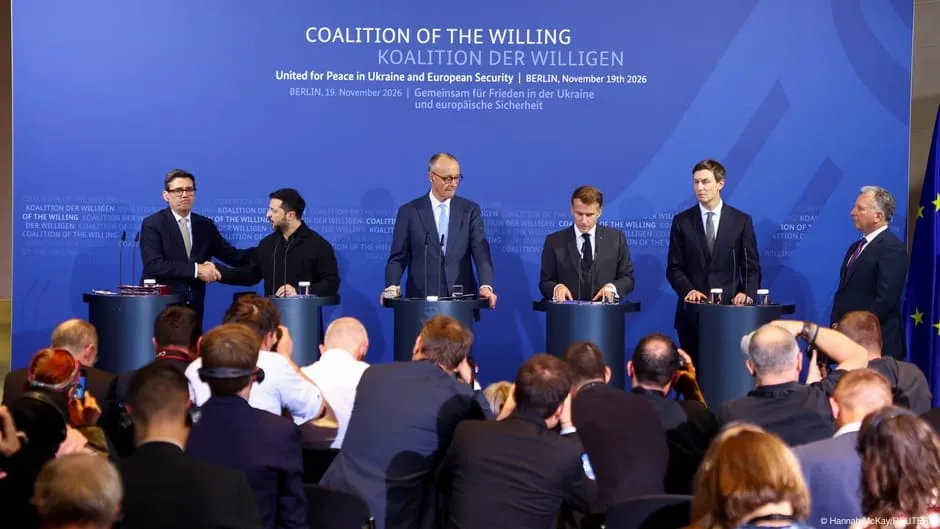
Peace in Ukraine: European leaders demand seat at negotiation table
European leaders are pushing for a central role in future negotiations to achieve peace in Ukraine, insisting that any settlement must include European representation alongside the US, Russia, and Ukraine. During the 'Coalition of the Willing' meeting in Berlin on November 19, 2026, leaders from Germany, France, the UK, and Ukraine reaffirmed their commitment to a just peace while condemning Russia's continued missile and drone attacks. The group emphasized the need for legally binding security guarantees and proposed a European-led Multinational Force Ukraine to support Kyiv once a ceasefire is established.
November 22, 2026
4 min read
Source: ASHENVOW
European allies seek inclusion in US-led negotiations
European leaders and US envoys have agreed that Europe requires a formal seat at the table during any future negotiations with Russia regarding the status of Ukraine. At the 'Coalition of the Willing' talks in Berlin, representatives from Germany, France, the UK, Poland, and Italy met to coordinate their stance following high-level discussions in China involving President Donald Trump, Russia's Vladimir Putin, and China's Xi Jinping.
US special envoy Jared Kushner noted that the unity expressed by European nations was clearly communicated to President Trump. According to Kushner, the message of strong European support for Ukraine would also be relayed to the Russian delegation. Kushner stated that while there is a "real desire for peace," the Berlin meeting has facilitated progress regarding what post-war security guarantees and prosperity plans could look like.
The role of US envoys in Berlin
The Berlin meeting included briefings from US envoys Steve Witkoff and Jared Kushner. These envoys provided updates on the recent trilateral discussions held in China between the United States, Russia, and China. Kushner indicated that President Trump had joined the Berlin meeting via telephone to provide these updates and expressed a desire to engage aggressively with both Moscow and Beijing to reach a peaceful resolution.
The 'Coalition of the Willing' joint statement on security
A joint statement issued by the leaders of Germany, France, the UK, and Ukraine condemned Russia's "systematic escalation of its deliberate and indiscriminate missile and drone attacks against Ukraine's civilians and civilian infrastructure." The leaders emphasized that Ukraine's right to defend itself remains paramount and highlighted the significant battlefield losses sustained by Russian forces.
To ensure long-term stability, the leaders outlined several strategic priorities for supporting Kyiv:
- Air Defense: Strengthening Ukraine's air defense capabilities is a primary priority to counter intensifying aerial bombardments.
- Economic Pressure: Targeting Russia's ability to fund its war effort through sanctions and increased pressure on oil and gas revenues, alongside efforts to impede the Russian "shadow fleet."
- Security Guarantees: Establishing robust and legally binding security arrangements once a ceasefire is in effect.
- Multinational Presence: The proposal of a "European-led Multinational Force Ukraine," composed of contributions from willing nations and supported by the United States.
The leaders also called for an immediate "energy ceasefire" for the duration of the winter as a preliminary step toward ending hostilities.
Divergent views on NATO and security frameworks
French President Emmanuel Macron argued that the question of Ukraine's accession to NATO should be reopened in light of Russia's "maximalist demands." Macron stated that the immediate priority must be ensuring Ukraine possesses the necessary tools to resist Russian aggression, specifically through the deployment of anti-missile systems and interceptors.
While Macron advocated for reconsidering NATO membership, US envoy Jared Kushner suggested that Russia appeared "comfortable" with the concept of NATO-like security guarantees for Ukraine as a means to end the conflict. This distinction highlights the ongoing complexity in defining what constitutes an acceptable security framework for both Kyiv and Moscow.
Required once a ceasefire is in place
| Proposed Security Measure | Proponent/Context | Status/Detail |
|---|---|---|
| NATO Accession | Emmanuel Macron (France) | Proposed to be reopened due to Russian maximalism |
| NATO-like Guarantees | Jared Kushner (US Envoy) | Reported as a concept Russia is "comfortable" with |
| Multinational Force Ukraine | Coalition of the Willing | European-led, US-supported; remains a Russian sticking point |
| Legally Binding Guarantees | Joint Statement (DE, FR, UK, UA) |
Addressing the Russian position
The French leadership maintains that security guarantees must be a core element of long-term negotiations. Macron insisted that the security plan previously submitted by allies should remain the foundation for these discussions, emphasizing that the capacity to protect Ukrainian citizens must be exercised immediately.
The demand for a multi-party negotiation format
German Chancellor Friedrich Merz criticized the recent trilateral discussions between the US, Russia, and China, labeling them a "photo op." Merz argued that such a "Yalta format" is insufficient to bring lasting peace to Ukraine. Instead, he advocated for a broader negotiation structure that includes Ukraine, Russia, the United States, and Europe.
Merz proposed that Germany, France, the UK, Poland, and Italy should act as the collective voice for Europe in these talks. He stated that this expanded format offers the best opportunity for securing a sustainable peace. To demonstrate long-term commitment, the German Chancellor also pledged "powerful support" for Ukraine extending into 2027, referencing the €45 billion already earmarked for assistance.
Zelenskyy's call for coordinated European participation
Ukrainian President Volodymyr Zelenskyy emphasized that Europe must be an integral part of all future negotiations. According to Zelenskyy, the United States understands that "strong and coordinated European participation at the negotiations is necessary" to ensure a successful outcome. He stressed that the international community must continue to push Russia to be more constructive in its diplomatic approach.
Zelenskyy also highlighted the immediate humanitarian and military necessity of increased support. He noted that Russian aerial bombardments are steadily intensifying and that there is currently no sign of de-escalation, as Russia has rejected previous proposals. For Ukraine, the role of the United States remains critical, with Zelenskyy stating it is "crucial" that Washington exerts its influence on Moscow to drive meaningful progress.



