
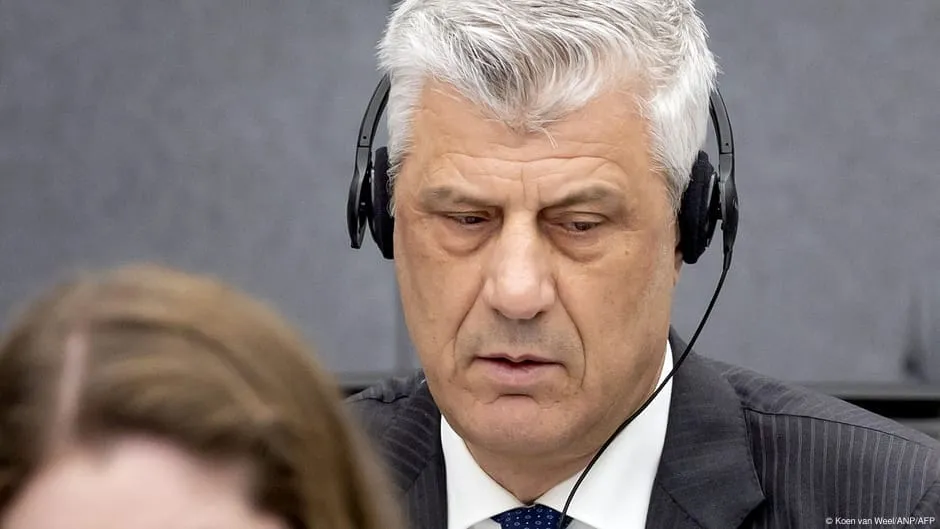
Hashim Thaci conviction: Second ruling in The Hague adds 17 months
The Hashim Thaci conviction for obstructing justice has added 17 months to the former Kosovo President's existing 25-year war crimes sentence. On Tuesday, a court in The Hague ruled that Thaci attempted to influence witnesses and provided confidential information to visitors at his detention facility. This second conviction by the Kosovo Specialist Chambers follows his September 16 ruling for war crimes. The decision has reignited intense political debate in Kosovo regarding the legitimacy of the court and the legal strategy for upcoming appeals.
November 21, 2026
4 min read
Source: ASHENVOW
Details of the obstruction of justice conviction
The Kosovo Specialist Chambers convicted former President Hashim Thaci of obstructing justice and attempting to influence witnesses during his ongoing war crimes trial. This ruling results in a 17-month prison sentence, which will be served in addition to the 25-year sentence handed down for war crimes on September 16, 2026. The indictment from the Specialist Prosecutor's Office detailed that Thaci used visitors at his Hague detention facility to pass confidential information regarding witnesses to others. These visitors were instructed on how to improperly influence the testimony of those involved in the trial.
The court's decision extended beyond Thaci to include three other individuals convicted alongside him for their roles in these activities:
- Bashkim Smakaj: Former head of the Kosovo Intelligence Agency.
- Hajredin Kuci: Former Minister of Justice.
- Fadil Fazliu: Convicted in connection with the obstruction attempts.
The scope of the prosecutor's indictment
According to the Specialist Prosecutor's Office, the interference was a calculated effort to undermine the integrity of the judicial process. By utilizing visitors to convey instructions and sensitive data, the defendants sought to manipulate the evidentiary foundation of the war crimes proceedings. This second layer of legal accountability highlights the court's focus on maintaining the sanctity of witness testimony in cases involving high-level political figures.
Political and governmental responses in Kosovo
The Kosovo government issued a swift response to the Tuesday ruling, emphasizing that judicial legitimacy depends on the fairness and transparency of the process. While Thaci is viewed as a hero by many for his leadership of the Kosovo Liberation Army (KLA) during the 1998-1999 war, the government has maintained a stance focused on procedural guarantees. A government statement noted, "Trust in justice is built not only on the decisions that are made, but also on the manner in which they are reached." Prime Minister Albin Kurti has characterized the initial September war crimes judgment as unjust from both legal and moral perspectives. To address this, the administration has taken specific institutional steps to challenge the court's findings through formal channels.
The government's current strategy includes:
- The Establishment of a Working Group: Chaired by Foreign Minister Glauk Konjufca, this group includes members of Kosovo's parliament and is tasked with drafting a strategy for the appeal proceedings.
- Securing Corrections: Prime Minister Kurti stated that the government is working to "secure a correction at the appeals level before the Specialist Chambers."
Legislative attempts to reform the Specialist Chambers
Beyond executive responses, the parliament of Kosovo is currently considering significant amendments to the law governing the Kosovo Specialist Chambers. These proposed changes aim to alter the fundamental operational parameters of the court. The draft law seeks to narrow the court's mandate and provide more flexibility regarding sentencing and jurisdiction.
| Proposed Amendment Area | Description of Change |
|---|---|
| Jurisdiction Period | Narrowing the specific time frame covered by the court's authority. |
| Maximum Sentencing | Limiting the maximum prison sentence to 15 years. |
| Sentence Location | Allowing convicted individuals to serve their sentences within Kosovo. |
| Pardon Powers | Introducing the possibility of presidential pardons for final court decisions. |
Implications for international relations
The attempt to amend the law while judicial processes are active carries significant diplomatic weight. Legal experts suggest that the timing of these legislative moves could be perceived by the international community as an interference in the judicial process, potentially impacting Kosovo's standing with international partners.
Legal and expert analysis of the judicial conflict
Legal experts and political analysts have highlighted a growing tension between Kosovo's domestic political sentiment and its international legal obligations. The debate centers on whether the current actions of the Kosovo parliament constitute legitimate legal criticism or an attempt to undermine the court's authority. Ehat Miftaraj, executive director of the Kosovo Law Institute (IKD), notes that while criticism is a right in a democratic society, there is a "fundamental distinction between criticism based on legal arguments and attempts to delegitimize courts or exert influence over judicial proceedings." Political analyst and university professor Artan Muhaxheri has warned that the current legislative initiatives must be handled with extreme professional rigor. He suggests that for these measures to be successful without causing a backlash, they must demonstrate that they do not conflict with Kosovo's obligations to the European Union.
The friction between the court and the state is compounded by several factors:
- Perception of Bias: Miftaraj stated that the judicial process has created an impression that international actors have treated the accused and Kosovo itself with "distrust, prejudice, and an often condescending approach."
- Historical Context: Objections to the court are deeply rooted in the emotional and historical context of the 1998-1999 war and the experiences of Kosovo's citizens.
- Institutional Legitimacy: The debate questions whether the Specialist Chambers, though established by the Kosovo parliament at the urging of the EU and US, still effectively serves the interests of the state it was designed to protect.



