
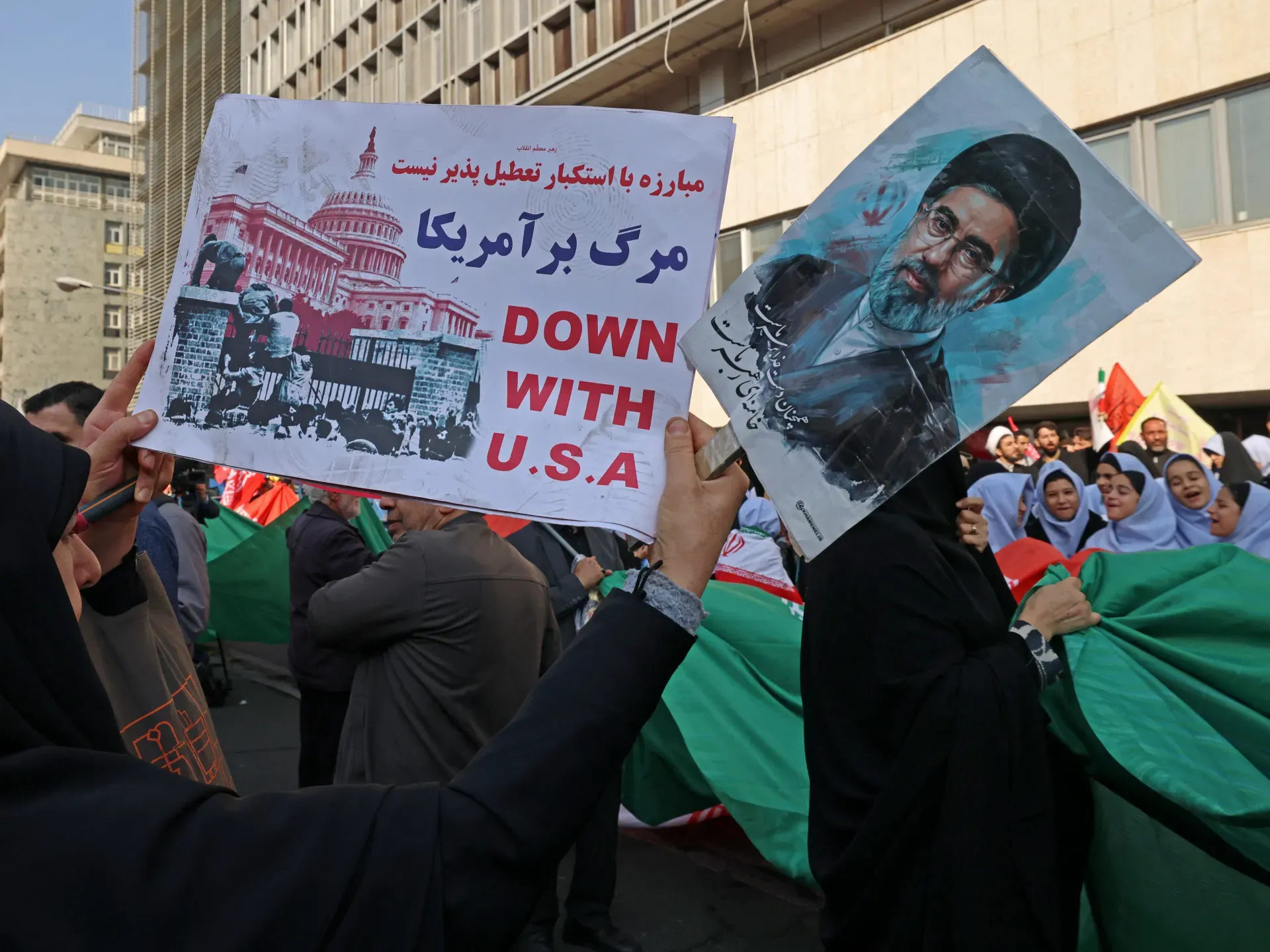
US-Israel war on Iran: How midterm election shifts impact conflict
The US-Israel war on Iran enters a period of heightened uncertainty following the US midterm elections, which saw Democrats secure historic victories in both chambers of Congress. While Iranian officials interpreted the Republican losses as a public rejection of military escalation, Supreme Leader Mojtaba Khamenei warned that American political shifts will not alter the fundamental hostility toward Iran. The conflict, which escalated significantly in February following an attack on Ali Khamenei's office, remains a central driver of regional instability. This article examines the reactions from Tehran and Washington, the potential for short-term escalation, and the strategic implications for the Strait of Hormuz.
November 8, 2026
5 min read
Source: ASHENVOW
How did US midterm election results influence Iranian rhetoric?
Iranian leadership has reacted to the US midterm elections with a mixture of strategic optimism and warnings of continued confrontation. Following the Democratic Party's victory in both houses of Congress, several high-ranking officials suggested that the American electorate has signaled a desire to move away from active military engagement. Mohammad Bagher Ghalibaf, Iran’s parliament speaker and chief negotiator with Washington, stated that Americans chose between 'conscience or the cost of living' and effectively said 'no to war.'
However, this conciliatory tone from some diplomats is sharply contrasted by the stance of the Supreme Leader. Mojtaba Khamenei, who has remained out of the public eye since the February assassination of his father, Ali Khamenei, issued a stern warning via his website. He argued that any expectation of a change in US policy due to partisan shifts is a misconception. According to Khamenei, the 'hegemonic system' will maintain its hostility regardless of which faction controls Congress.
Other Iranian officials also weighed in on the political shift in Washington. Mohammad Mokhber, an adviser to the Supreme Leader, characterized the election results as a blow to President Donald Trump, suggesting that Iran has successfully transferred the economic and political costs of the ongoing conflict onto the United States. Despite these perceptions of a political victory, the underlying military tension remains high.
What is the current stance of the Trump administration on the conflict?
President Donald Trump has acknowledged that the US-Israel war on Iran likely contributed to the Republican Party's poor midterm performance, though he attributed the primary cause to domestic economic factors. In an interview with Fox News, Trump argued that voters were reacting to rising gasoline prices rather than the military campaign itself. He suggested that while the public might support his general stance on Iran, they were unwilling to endure the short-term financial consequences of the war.
Trump's military readiness and political motivations
Despite the electoral setback, Trump has not ruled out further military action. He indicated that there is significant pressure within his administration and political circles to execute what he described as a 'heavy hit' against Iranian targets. This suggests that while the political mandate for the war may be wavering, the executive intent to continue or escalate remains a possibility.
In a separate discussion with the Financial Times, Trump described himself and his administration as 'locked and loaded' if military action becomes necessary. However, he also noted that a negotiated solution remains a potential path, stating there may be no immediate reason to launch further strikes. This duality—maintaining readiness for a major strike while leaving the door open for diplomacy—defines the current US executive position.
Will the Democratic victory lead to escalation or de-escalation?
The transition of power to a Democratic-controlled Congress creates a volatile period of uncertainty for the Middle East. Analysts suggest that the window between the midterm results and the official change in Congressional control in January is a high-risk timeframe. Trita Parsi, executive vice president of the Quincy Institute for Responsible Statecraft, warned that the Democratic victory could paradoxically trigger a short-term escalation by the Trump administration.
Parsi noted that Trump has historically exhibited a pattern of becoming more reckless when facing political humiliation or defeat. There is a concern that the President may attempt to 'rampage' or launch attacks out of a desire for revenge to compensate for his electoral loss. This period is particularly dangerous because the incoming Democratic majority may attempt to use their new authority to restrict the funding required to sustain the military campaign.
What are the strategic risks regarding the Strait of Hormuz?
The Strait of Hormuz remains a critical flashpoint in the US-Israel war on Iran, with Iran asserting significant control over the waterway. Supreme Leader Mojtaba Khamenei claimed that Iranian influence in the region has effectively shattered the 'myth of America's invincibility.' This strategic positioning allows Iran to leverage its control over global energy transit as a deterrent against renewed US aggression.
Iranian military officials have signaled that their response to further US strikes will extend far beyond traditional military targets. Hamidreza Moghadamfar, an adviser to the commander-in-chief of the Islamic Revolutionary Guard Corps (IRGC), stated during a rally in Bandar Abbas that Iran is prepared to hit targets beyond US bases. He specifically mentioned that if Gulf states like the United Arab Emirates or Bahrain allow Washington to launch attacks from their territory, Iran will respond using 'new doctrine and new technology.'
Frequently asked questions
How has the US political landscape changed regarding the Iran war?
The US midterm elections resulted in a historic Democratic victory, with the party taking control of both the House and the Senate. While some Iranian officials see this as a public rejection of the war, US analysts warn that the Trump administration might react to this political defeat with increased military aggression.
What is the current status of the Supreme Leader in Iran?
Mojtaba Khamenei is the current Supreme Leader of Iran. He has not appeared in public since the February assassination of his father, Ali Khamenei, in a US-Israeli attack. His recent statements emphasize that US political changes will not alter the fundamental hostility between the two nations.
Why does Trump link the war to gasoline prices?
President Trump has argued that the Republican Party's midterm losses were driven by the economic impact of the conflict, specifically rising petrol costs. He maintains that while voters may agree with his Iran policy, they are prioritizing the short-term cost of living over military objectives.
What are the risks for Gulf states in this conflict?
Gulf states, including the UAE and Bahrain, face the risk of being targeted by Iran if they allow the US to use their territory to launch attacks. Iranian IRGC advisers have explicitly warned that any such cooperation would trigger a response involving new military doctrines.
How does the Strait of Hormuz factor into the conflict?
The Strait of Hormuz is a vital maritime chokepoint. Iran uses its control over this area to project power and challenge US military dominance, claiming that their ability to manage the strait proves that American invincibility is a myth.
Key takeaways
- Democratic victories in both US Congressional chambers have created a volatile political transition period.
- Supreme Leader Mojtaba Khamenei warns that US partisan shifts will not end hostility toward Iran.
- President Trump attributes Republican midterm losses to high gasoline prices rather than the war.
- Iranian officials have threatened to target regional allies if they facilitate US military strikes.
- The period before the January transition is identified as a high-risk window for escalation.
Conclusion
The geopolitical landscape surrounding the US-Israel war on Iran is currently defined by a tension between domestic political shifts in Washington and entrenched military posturing in Tehran. While the Democratic sweep of Congress offers a potential path toward redirected funding and different diplomatic priorities, the immediate future remains clouded by the risk of retaliatory strikes from a weakened Trump administration. As Iran continues to leverage its strategic position in the Strait of Hormuz, the international community faces a precarious window of time where political volatility could easily translate into expanded regional conflict.



