
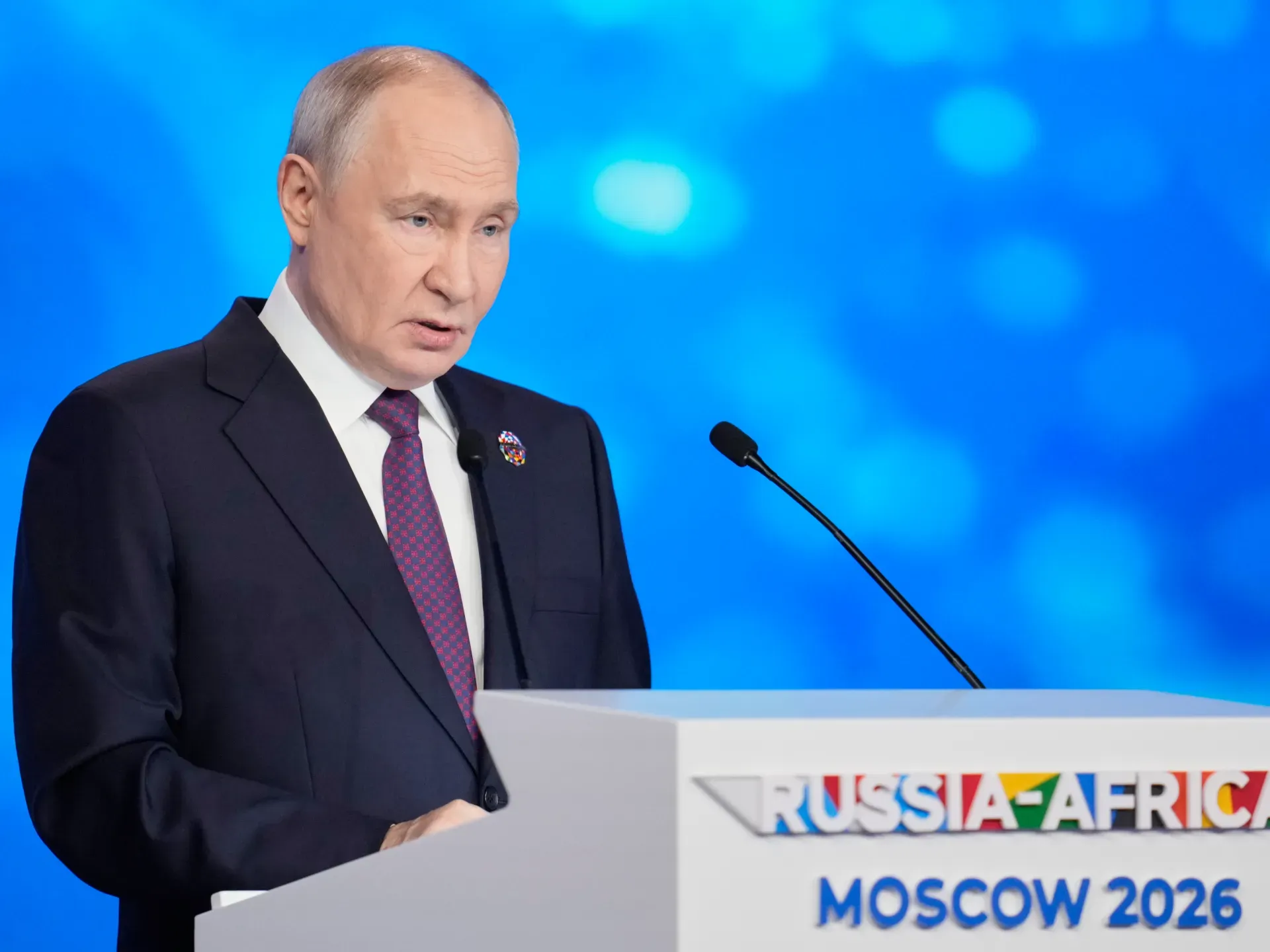
Russia-Africa Summit 2026: Putin rejects neo-colonialism claims
The Russia-Africa Summit 2026 in Moscow has seen President Vladimir Putin position Russia as an alternative to Western powers by explicitly denying engagement in "neo-colonial exploitation." Addressing delegations from 48 African nations on October 28, 2026, Putin argued that Western nations use debt to hinder development. He noted that Russia has already supplied 13 million metric tonnes of agricultural products to the continent during the first nine months of the year. This article examines Putin's rhetoric regarding multipolarity, the strategic importance of agricultural exports, and the security context of the summit.
November 8, 2026
5 min read
Source: ASHENVOW
The Russia-Africa Summit 2026 in Moscow has seen President Vladimir Putin position Russia as an alternative to Western powers by explicitly denying engagement in "neo-colonial exploitation." Addressing delegations from 48 African nations on October 28, 2026, Putin argued that Western nations use debt to hinder development. He noted that Russia has already supplied 13 million metric tonnes of agricultural products to the continent during the first nine months of the year. This article examines Putin's rhetoric regarding multipolarity, the strategic importance of agricultural exports, and the security context of the summit.
What is the core message of Putin at the Russia-Africa Summit 2026?
President Vladimir Putin has framed Russia as a non-predatory partner to African nations, specifically contrasting Moscow's approach with that of former colonial powers. During the third Russia-Africa Summit held in Moscow on Wednesday, October 28, 2026, Putin asserted that Russia does not engage in the "neo-colonial exploitation" of the continent's natural and human resources.
According to the President, the primary distinction between Russian involvement and Western influence lies in the economic structure of their partnerships. He claimed that while Western countries attempt to drive African nations into debt traps and impose predatory financial terms, Russia focuses on expanding the local processing of raw materials. This strategy, he argued, is designed to create local employment and generate domestic tax revenue rather than simply extracting wealth.
Putin's rhetoric is clearly aimed at the growing sentiment of sovereignty across the continent. He acknowledged that Africa is increasingly asserting itself as a pivotal player in global politics and the international economy. However, he cautioned that the transition toward a multipolar world is facing significant resistance from established powers unwilling to accept this shifting reality.
How is Russia positioning itself against Western economic influence?
Russia is positioning itself as a counterweight to Western financial systems by criticizing the use of debt as a tool for developmental restriction. Putin stated that Western countries actively attempt to force African nations to accept financial resources on terms that are predatory, which he believes slows long-term progress on the continent.
The summit serves as a platform for Russia to present its economic model as a more sustainable alternative. By emphasizing local value addition—processing raw materials within Africa rather than just exporting them—Moscow seeks to appeal to leaders looking for industrialization without the historical baggage of colonial extraction. This approach is intended to foster a sense of mutual benefit rather than dependency.
The debate over debt and development
The criticism of Western financial mechanisms is a central pillar of Russia's diplomatic outreach in Africa. Putin’s comments suggest that Moscow views the current global financial architecture as a mechanism for maintaining Western hegemony. By characterizing Western aid and loans as tools for "driving Africans back into debt," Putin attempts to align Russian interests with the decolonization movements and the desire for economic autonomy seen in many African states.
What role does food security play in the Russia-Africa relationship?
Agricultural cooperation is a cornerstone of the summit's agenda, with Russia emphasizing its capacity to expand the delivery of essential food supplies. Putin informed the delegations, which included 22 heads of state, that Russia is prepared to increase the geographical reach of its agricultural shipments to Africa.
The scale of Russian agricultural involvement is significant. According to the summit proceedings, Russia supplied 13 million metric tonnes of agricultural products to Africa in the first nine months of 2026 alone. This makes food security a critical lever in Russia's diplomatic strategy, especially as global supply chains face ongoing volatility.
The timing of these commitments is particularly relevant given the current global landscape. The summit takes place amidst continued disruptions in the Black Sea, which have impacted grain exports from both Russia and Ukraine. Furthermore, the conflict involving the United States, Israel, and Iran has caused interruptions in the global supply of fertilizers, making Russia's role as a supplier of both food and agricultural inputs even more strategically vital for African stability.
How does the security landscape affect the summit's objectives?
The summit occurs against a backdrop of significant regional instability, with Russian-backed forces in parts of North Africa engaged in fighting armed rebellions. Many countries in the region are also navigating the aftermath of military coups that have fundamentally shaken regional security frameworks.
Security is one of the primary topics for the scheduled one-on-one talks between President Putin and various African leaders. These discussions are expected to cover a wide range of sensitive issues, including:
- Arms deals and military cooperation.
- Regional stability and counter-insurgency efforts.
- Protection of trade routes and maritime security.
The interplay between security and trade is evident. As Russia seeks to deepen its footprint through defense agreements, it simultaneously uses its role in food security to build political capital. The summit is expected to conclude with a final declaration aimed at deepening the multifaceted cooperation between Russia and the 48 participating African nations.
FAQ: Russia-Africa Summit 2026
What did Putin say about neo-colonialism?
Putin stated that Russia does not engage in the neo-colonial exploitation of Africa's natural and human resources. He contrasted this with Western powers, whom he accused of using debt and predatory financial terms to exploit the continent and hinder its long-term development.
How much agricultural product has Russia sent to Africa in 2026?
According to the summit reports, Russia supplied 13 million metric tonnes of agricultural products to the African continent during the first nine months of 2026. Putin expressed a readiness to expand these shipments to more regions.
Which African nations were represented at the summit?
The summit included delegations from 48 African countries. Of these, 22 were represented directly by their heads of state, highlighting the high-level diplomatic nature of the meeting in Moscow.
What are the main topics of the bilateral talks?
Individual African leaders are scheduled to hold one-on-one talks with Putin. These discussions will cover critical areas such as trade, security, grain supplies, and potential arms deals between Russia and various African nations.
Why is global food security currently unstable?
Global food security is being impacted by disruptions in the Black Sea affecting grain exports, as well as conflicts in the Middle East involving the US, Israel, and Iran, which have interrupted the supply of essential fertilizers.
Key takeaways
- Putin rejected claims of neo-colonialism, positioning Russia as a partner that supports local resource processing.
- Russia delivered 13 million metric tonnes of agricultural products to Africa in the first nine months of 2026.
- The summit addressed the transition toward a multipolar world and resistance from established Western powers.
- Security concerns, including regional rebellions and military coups, remain central to the Russia-Africa dialogue.
The strategic shift toward multipolarity
The 2026 Russia-Africa Summit underscores a significant effort by Moscow to consolidate its influence in a rapidly changing geopolitical landscape. By framing its involvement through the lens of anti-colonialism and economic empowerment via local processing, Russia is attempting to bypass traditional Western diplomatic channels. However, the success of this approach remains tied to its ability to navigate the complex security realities of the continent and the ongoing volatility of global commodity markets. As African nations continue to assert their role in the global economy, the competition for influence between Russia and the West is likely to intensify.



