
Protests in France: Massive marches over cost of living
Massive protests in France occurred on October 31, 2026, as hundreds of thousands of demonstrators took to the streets for a third consecutive weekend. According to authorities, 320,000 people participated nationwide, including 70,000 in Paris, to voice grievances regarding the cost of living and the deteriorating state of the national education system. The demonstrations led to significant clashes between police and protesters in several cities, resulting in at least 290 arrests. This article examines the causes of the unrest, the scale of the violence in Paris and Lyon, and the broader context of social instability across Europe.
November 8, 2026
5 min read
Source: ASHENVOW
Why are people participating in these protests in France?
The current wave of unrest is driven by a combination of economic pressure and systemic failures within the French education system. What began as a movement led by high school students has since expanded into a broader coalition involving university students and various labour unions.
The core grievances of the protesters focus on several critical areas of public life. Students have specifically highlighted the neglect of school buildings, chronic teacher shortages, and an admissions process for universities that they perceive as being fundamentally unfair to students from disadvantaged backgrounds. These educational concerns have merged with wider socio-economic anxieties regarding the rising cost of living, which has impacted households across the country.
The intensity of the movement is reflected in the scale of participation. While a coalition of youth organisations and unions estimated that nearly half a million people took part in the demonstrations, the French Ministry of Interior reported a nationwide turnout of 320,000. This represents the third consecutive weekend of significant demonstrations, indicating a sustained level of public dissatisfaction that the government is struggling to contain.
How did the demonstrations in Paris and Lyon escalate into violence?
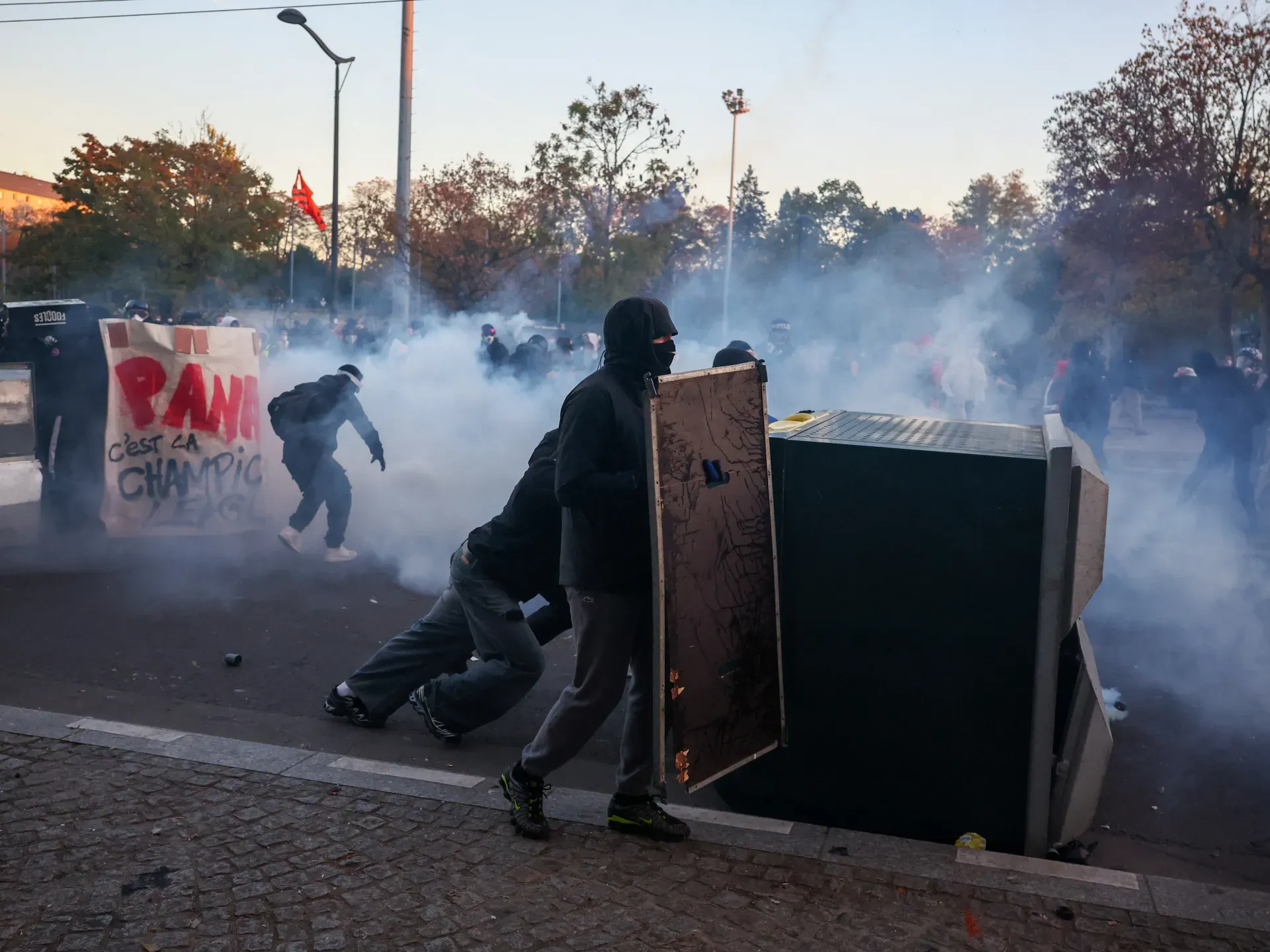
Clashes between security forces and demonstrators broke out in major cities, most notably in Paris and Lyon, as marches transitioned from peaceful gatherings to scenes of civil disorder. In the capital, the situation deteriorated as protesters converged near the intended end point of the main march.
Reports from the ground indicated significant destruction and confrontation. Protesters set fire to street furniture and bins, creating plumes of smoke that were visible across the city. According to the AFP news agency, masked individuals dressed in black were observed using hammers to remove paving stones, which were then hurled at police officers. In at least one instance, an incendiary device was thrown at security forces.
The police response and the scale of arrests
In response to the escalating violence, riot police utilized tear gas and baton charges to disperse crowds. In Paris, police used loudspeakers to issue warnings, stating they would deploy more tear gas if the streets were not cleared. The intensity of the gas deployment was significant enough that journalists on the scene reported difficulty breathing. The Ministry of Interior confirmed that at least 290 people were arrested nationwide during the Saturday rallies.
The deployment of security forces was massive, with approximately 70,000 police and gendarmes stationed across the country to manage the unrest. Authorities also implemented specific restrictions, such as a 9pm curfew for unaccompanied minors around the Champs-Elysees, to mitigate the risk of further disorder.
What is the government's response to the growing unrest?
The French government is attempting to balance heavy-handed security measures with political negotiations to address the root causes of the protests. Prime Minister Sebastien Lecornu has engaged in direct dialogue with student unions throughout the week, seeking to find a path toward de-escalation.
The administration is currently evaluating several measures aimed at easing the cost of living for citizens. However, the effectiveness of these measures remains to be seen, as many protesters express a profound lack of confidence in official promises. Observers noted that while many participants condemned the violence, there is a pervasive sense that the government has failed to listen to the public's concerns, leading to a breakdown in institutional trust.
Security remains a primary concern for the Ministry of Interior. Interior Minister Laurent Nunez has warned of a "very high risk" of further disorder, particularly as the protests coincide with the Halloween period. The government is maintaining a high state of alert to prevent the kind of widespread looting and rioting that occurred during previous demonstrations on October 17.
Is this social unrest limited to France?
The demonstrations in France are part of a broader trend of social instability and protest activity currently being observed across several European nations. Rising costs and perceived cuts to public services have become common catalysts for mass mobilization in the region.
In Germany, the unrest has taken a similar form. On the same Saturday, thousands of young people gathered in Cologne to protest against increasing costs, cuts to education funding, and proposed plans for military conscription. Organisers in Germany reported that approximately 170,000 people had registered for demonstrations across more than 30 cities, with police deploying water cannons to manage the crowds.
Spain has also experienced significant tension. In Barcelona, regional police were placed on their highest alert level following rioting on October 24. That specific incident resulted in approximately 130 arrests, the majority of whom were minors. This pattern suggests that the economic and social pressures driving the French protests are part of a wider European phenomenon of public discontent.
Frequently asked questions
What are the primary causes of the protests in France?
The protests are fueled by two main issues: the rising cost of living and the state of the French education system. Students are specifically protesting against teacher shortages, poorly maintained school buildings, and perceived inequalities in university admissions processes.
How many people participated in the October 31 demonstrations?
There is a discrepancy between official and unofficial figures. The French Ministry of Interior reported 320,000 participants nationwide, while a coalition of youth organisations and unions estimated the number to be nearly 500,000 people.
What happened during the clashes in Paris?
While marches began peacefully, they turned violent near the end of the routes. Protesters set fire to street furniture and used paving stones as projectiles, while police responded with tear gas and baton charges to disperse the crowds.
How many people have been arrested?
According to the French Ministry of Interior, at least 290 people were arrested across the country during the demonstrations on Saturday, October 31, 2026.
Are there similar protests happening in other European countries?
Yes, similar unrest has been reported in Germany, where thousands protested in Cologne over education cuts and military conscription, and in Spain, where Barcelona saw significant rioting and numerous arrests in late October.
Key takeaways
- Nationwide protests in France reached 320,000 participants on October 31, 2026.
- The unrest is driven by cost-of-living concerns and educational system failures.
- At least 290 people were arrested during the nationwide demonstrations.
- Security forces deployed 70,000 personnel to manage the widespread unrest.
- Similar protests regarding economic and social issues are occurring in Germany and Spain.
Conclusion
The massive demonstrations across France underscore a deepening crisis of confidence between the citizenry and the state. As hundreds of thousands of people, particularly the youth, demand improvements to the education system and relief from economic pressures, the government faces the difficult task of addressing structural issues while maintaining public order. With significant security deployments in place and a high risk of further disorder, the coming weeks will be critical in determining whether political negotiations can restore stability or if the cycle of unrest will continue to expand across the European continent.



