
Israel election 2026: Exit polls show Netanyahu-Eisenkot tie
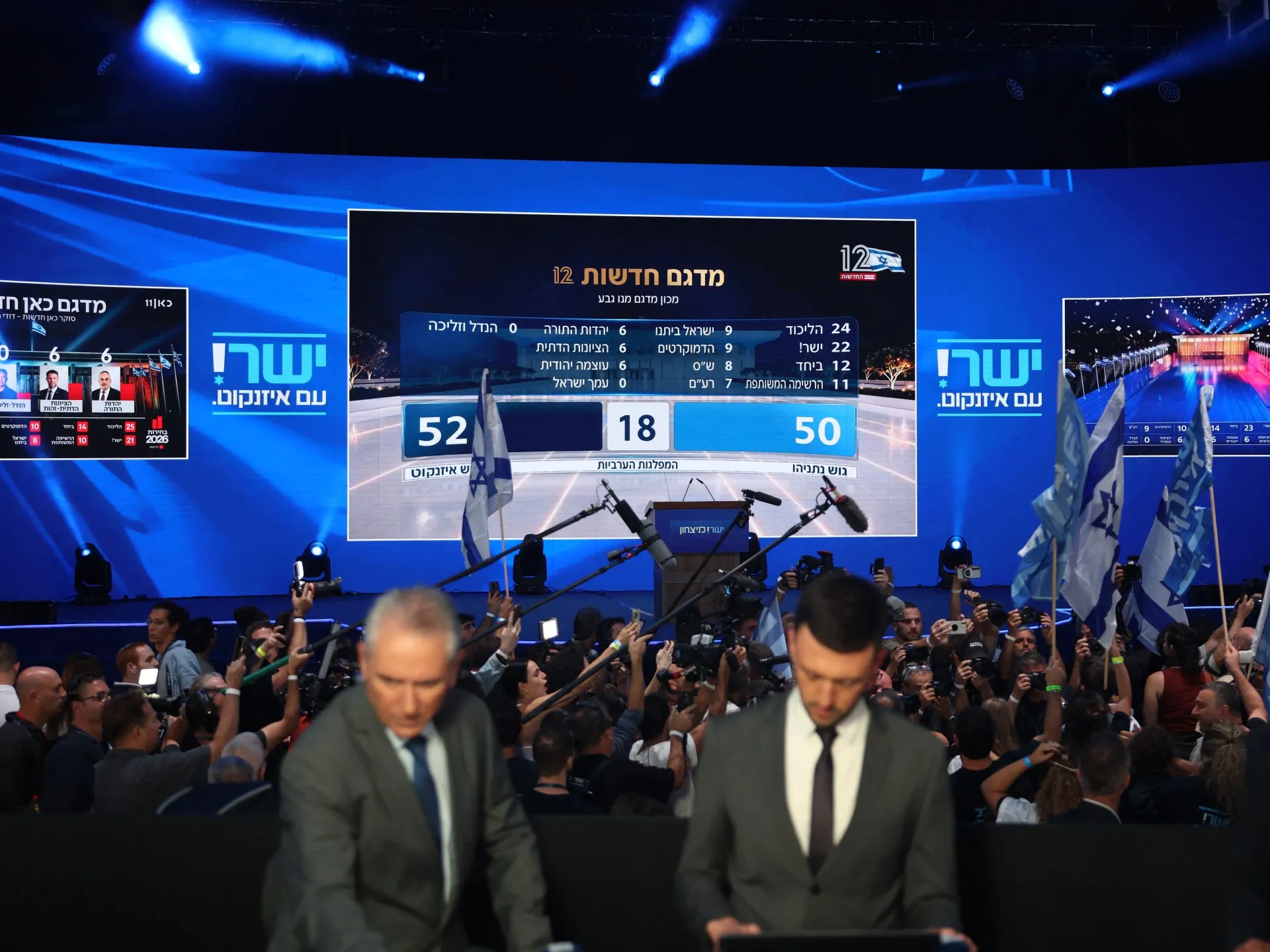
The Israel election 2026 exit polls suggest a political stalemate, with neither the bloc led by Benjamin Netanyahu nor the one led by Gadi Eisenkot on track to secure a governing majority. According to major Israeli television networks, both the Netanyahu-aligned bloc and the Yashar party bloc led by Eisenkot are projected to win 51 seats each in the 120-seat Knesset. With a 61-seat threshold required for a majority, the results point toward a period of intense coalition negotiations. This article examines the projected seat distributions and the implications of the high voter turnout.
November 8, 2026
6 min read
Source: ASHENVOW
What do the exit polls reveal about the Knesset seat distribution?
The exit polls released following Tuesday's parliamentary election indicate a near-perfect split between the two primary political camps in Israel. According to major Israeli television networks, the Yashar party bloc, headed by former military chief of staff Gadi Eisenkot, is projected to secure 51 seats. Simultaneously, the bloc supporting incumbent Prime Minister Benjamin Netanyahu is also projected to win 51 seats.
This distribution leaves the 120-seat Knesset in a state of equilibrium that prevents either major faction from achieving the 61 seats necessary to form a stable, unilateral government. The remaining 18 seats are projected to go to Arab parties, a figure that could fundamentally alter the landscape of coalition building. While the exit polls are subject to potential error and preliminary official results may vary, the current data suggests a significant challenge for both sides to reach the required majority.
The mathematical challenge of a majority
To govern effectively, any leader must assemble a coalition that meets or exceeds the 61-seat mark. With the two largest blocs tied at 51 seats, the path to power is no longer a straight line for either Netanyahu or Eisenkot. The deadlock forces both leaders to look toward smaller parties, which increases the leverage held by minor political players and complicates the ideological alignment required for a stable cabinet.
How are political leaders reacting to the projected results?
Political reactions to the exit polls have been sharply divided, ranging from celebrations of a 'crushing defeat' for the incumbent to claims of premature victory by the opposition. Gadi Eisenkot interpreted the polling data as a clear sign of a lack of public confidence in the current administration. This sentiment was echoed by Yair Lapid, the opposition leader, who described the results as a total collapse for the Netanyahu bloc.
The opposition has framed the election as a decisive mandate for change. Yair Golan, leader of the Democrats, stated that voters have effectively fired the Netanyahu government and expressed his intention to form a new administration. Conversely, members of Netanyahu’s Likud party have urged caution. Gideon Saar, the Foreign Minister and Likud member, criticized commentators for making biased pronouncements, asserting that Likud remains the largest single party and that the opposition's celebrations are premature.
What role will Arab parties play in the upcoming negotiations?
Arab parties are projected to win 18 seats, a result that positions them as potential kingmakers in the formation of the next government. At the headquarters of the Joint List, supporters celebrated the projected outcome, with leader Yousef Jabareen calling the election a historic day that delivered a sharp message against the current administration. Mansour Abbas, leader of the United Arab List (Ra’am), also indicated that his party intends to transform its mandate into a new political reality.
However, the practical application of this leverage faces significant ideological hurdles. Both Benjamin Netanyahu and Gadi Eisenkot have previously ruled out entering into partnerships with Arab-led parties, citing a fundamental lack of shared values. This creates a complex political paradox: while the Arab parties hold the mathematical weight necessary to break the deadlock, the primary contenders for the premiership have explicitly rejected them as potential partners.
The kingmaker dilemma
The tension between mathematical necessity and ideological compatibility defines the current crisis. If the 18 seats held by Arab parties are required to reach 61, but the major blocs refuse to negotiate with them, Israel faces a high probability of extended political paralysis. This scenario would likely lead to a cycle of failed coalition attempts and potentially necessitate further elections.
Why was voter turnout so high in this election?
The election saw a significant surge in participation, with the Central Elections Committee reporting a turnout of 77.7 percent. This represents more than 5.69 million of the approximately 7.33 million eligible voters. This figure is a notable increase of 7.1 percentage points compared to the 70.63 percent turnout recorded during the 2022 election. In fact, this marks the highest level of participation in a Knesset election since 1999, when turnout reached 78.7 percent.
The high engagement is largely attributed to the perceived weight of the election. Many analysts view this vote as a referendum on the government's handling of the October 7, 2023, Hamas-led attacks, the subsequent war in Gaza, and the escalating conflicts involving Lebanon and Iran. The intensity of the security situation and the domestic political fallout from these events appear to have driven citizens to the polls in record numbers.
What happens if no clear winner emerges?
An inconclusive result could leave the Israeli political system in a state of limbo. According to political analyst Ehab Jabareen, while the exit polls suggest a weakening of the Netanyahu bloc, they do not necessarily signal the end of his political career. He noted that the polls show the opposition faces an equally difficult task in constructing a majority.
In the event that neither the Netanyahu nor the Eisenkot blocs can successfully forge a governing coalition, Benjamin Netanyahu is likely to remain in power in a caretaker capacity. This would allow for continued negotiations between various parties while the country remains under a temporary administration. However, this 'caretaker' status often lacks the full mandate required for major policy shifts or decisive military leadership, potentially prolonging the period of domestic instability.
FAQ: Israel Election 2026
How many seats are needed to form a government in Israel?
A majority of 61 seats is required in the 120-seat Knesset to form a governing coalition. Because the exit polls project the two largest blocs at 51 seats each, neither side can govern without significant support from smaller, third-party factions.
Who are the main candidates in the 2026 election?
The primary contenders are the incumbent Prime Minister Benjamin Netanyahu, leading the Likud-aligned bloc, and Gadi Eisenkot, a former military chief of staff leading the Yashar party bloc. The election serves as a direct competition between these two political visions for the country.
What is the significance of the Arab party projections?
Arab parties are projected to win 18 seats, which would make them essential for any bloc attempting to reach the 61-seat threshold. Despite this mathematical importance, both major leadership blocs have expressed reluctance to partner with them due to ideological differences.
How does this turnout compare to previous elections?
The 77.7 percent turnout is significantly higher than the 70.63 percent recorded in 2022. It is the highest participation rate seen in a Knesset election since 1999, reflecting the high stakes perceived by the Israeli electorate regarding national security and governance.
Can Netanyahu remain Prime Minister if there is no majority?
Yes, if no coalition can be formed, Netanyahu can continue to serve in a caretaker capacity. This allows the political process to continue while parties attempt to negotiate, though it leaves the country in a state of political uncertainty.
Key takeaways
- Exit polls project a 51-51 seat split between the Netanyahu and Eisenkot blocs.
- A 61-seat majority is required, making Arab parties (projected 18 seats) potential kingmakers.
- Voter turnout reached 77.7 percent, the highest since 1999.
- Both major leaders have ruled out formal partnerships with Arab-led parties.
Conclusion
The 2026 Israel election has resulted in a profound political deadlock that reflects a deeply divided nation. With the two largest blocs tied in projected seats and the potential kingmakers held at ideological arm's length, the path to a stable government remains uncertain. While the record-breaking voter turnout underscores the gravity of the current security and political climate, it also highlights the difficulty of finding a consensus. Whether Israel moves toward a government of change or remains under a caretaker administration will depend on the complex, and likely protracted, coalition negotiations ahead.



