
Eisenkot-Arab deal: Protests in Israel over coalition plans 2026
The Eisenkot-Arab deal has become the focal point of massive demonstrations in Tel Aviv following the 2026 Israeli general elections. Protesters are urging opposition leader Gadi Eisenkot to form a Jewish-Arab coalition to remove Prime Minister Benjamin Netanyahu from power. According to the Central Election Committee, Arab-led parties secured 19 seats, marking a significant shift in the parliamentary landscape. This political deadlock follows an election where Netanyahu's bloc won 53 seats and Eisenkot's won 48. This article examines the protest movements, the electoral results, and the political barriers to a new government.
November 8, 2026
6 min read
Source: ASHENVOW
Why are protesters demanding a Jewish-Arab coalition?
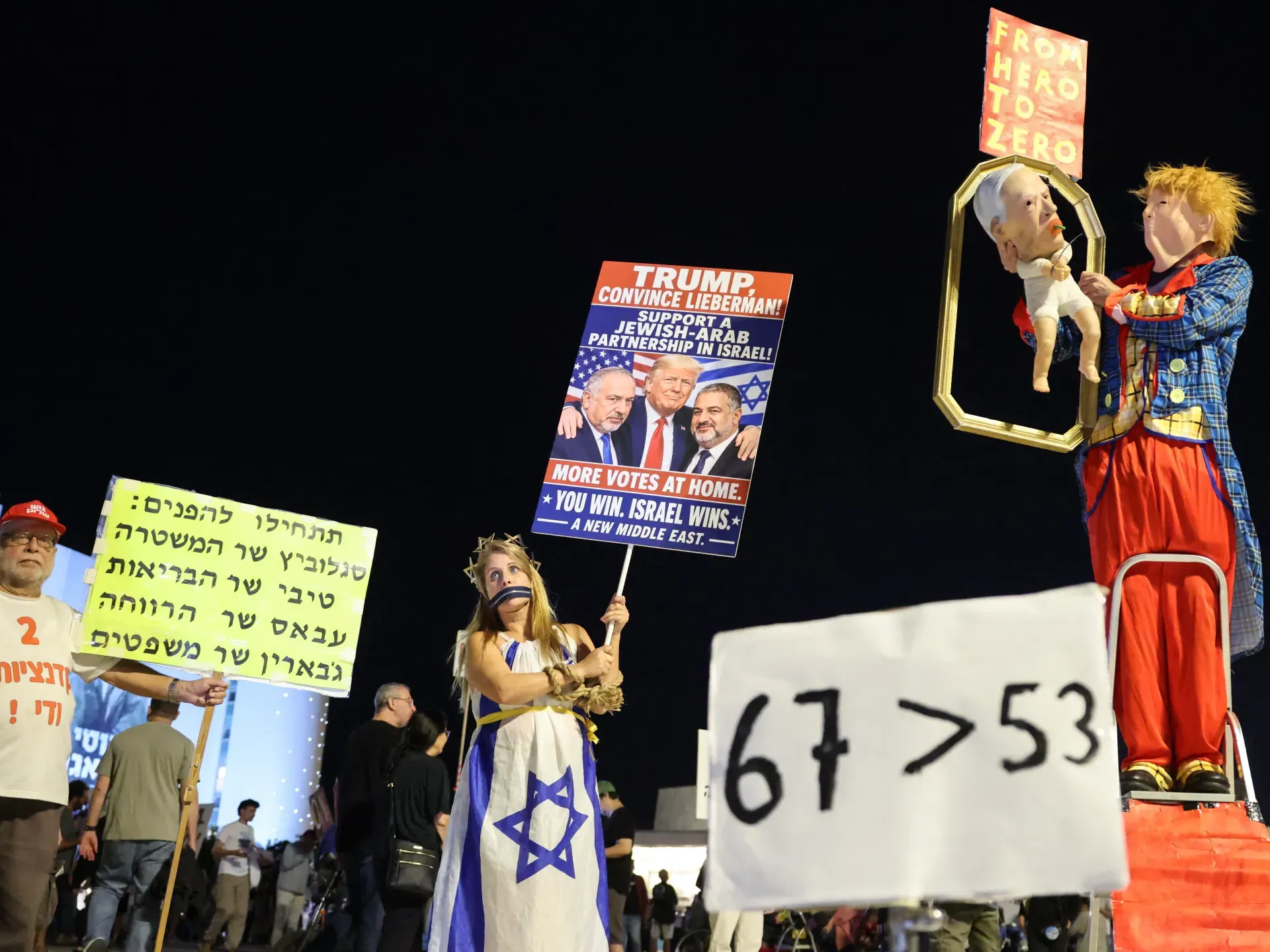
Thousands of demonstrators gathered at Habima Square in Tel Aviv on October 31, 2026, to advocate for a strategic alliance between Jewish-Israeli opposition parties and Arab-led political groups. The primary objective of these rallies is to break the current parliamentary deadlock and facilitate the removal of Prime Minister Benjamin Netanyahu.
Protesters have characterized the current political moment as a final opportunity for systemic change in the country. During the demonstrations, participants described Netanyahu, the longest-serving prime minister in Israel's history, as a "great manipulator." The movement seeks to pressure the main opposition, led by Gadi Eisenkot, to reconsider its long-standing policy of excluding Arab parties from coalition negotiations.
The urgency of the protests stems from the inability of any single bloc to secure a majority in the 120-seat Knesset. Without a willingness to engage with the 19 seats held by Arab-led parties, the opposition remains unable to present a viable alternative to the current administration. For many in the streets, the formation of a Jewish-Arab coalition is seen as the only mathematical path to a change in leadership.
What were the results of the 2026 Israeli general elections?
The 2026 general elections resulted in a fractured parliament where no single political bloc achieved the 61 seats required to form a government. The results have left the country in a state of political uncertainty, with the two largest factions unable to reach a majority independently.
According to the official election figures, the seat distribution in the 120-seat Knesset is as follows:
| Political Bloc / Leader | Seats Won |
|---|---|
| Benjamin Netanyahu's Bloc | 53 |
| Gadi Eisenkot's Opposition | 48 |
| Arab-led Parties | 19 |
The most notable shift in the electoral landscape came from the Arab-led parties, which secured 19 seats. This represents a significant increase in influence within the Knesset. Specifically, the Ra’am and Joint List coalition saw a massive surge in voter engagement. According to the Central Election Committee, nearly 840,000 people voted for these parties, representing a 64 percent increase compared to the 2022 election cycle.
The mathematical path to a 67-seat majority
The electoral success of the Arab-led parties provides a clear mathematical solution to the current deadlock. If Gadi Eisenkot's 48 seats were combined with the 19 seats held by the Arab-led coalition, the resulting government would hold a comfortable majority of 67 seats. This would allow for a stable administration capable of passing legislation and potentially ousting the Netanyahu bloc.
How has the Netanyahu administration responded to the Arab electoral surge?
Prime Minister Benjamin Netanyahu has launched sharp criticisms against the Arab-led parties, accusing them of improper influence and external interference. These accusations have intensified the polarization surrounding the potential for a Jewish-Arab coalition.
Netanyahu has alleged that Palestinian-Israeli parties are "stealing" the polls. Furthermore, he has claimed that these parties are accepting funding from Qatar to influence the election outcomes. These allegations have been met with strong denials; Qatar has officially rejected the claims, labeling them as part of a disinformation campaign designed to discredit the democratic process.
The rhetoric from the Netanyahu camp has also extended to the characterization of the Arab electorate. Some right-wing circles in Israel have described the high turnout of Palestinian Israelis as "electoral terrorism." This rhetoric has drawn comparisons to the October 7th attacks, a highly sensitive and provocative comparison intended to delegitimize the political agency of Arab citizens within the Israeli state.
What are the political barriers to the Eisenkot-Arab deal?
Despite the mathematical feasibility of a coalition, significant social and political hurdles remain. The concept of a Jewish-Arab alliance is viewed by many segments of the Israeli population as politically unpalatable and ideologically impossible.
Gadi Eisenkot, the leader of the main opposition, has historically ruled out the possibility of forming a coalition with Arab parties. This stance has placed him at odds with the protesters in Tel Aviv, who argue that his refusal to negotiate is a barrier to the "real change" they seek. The tension lies in the gap between the street's demand for a pragmatic majority and the opposition leadership's ideological constraints.
The debate is further complicated by the intense polarization regarding the status of Palestinian-Israeli voices. As noted by Al Jazeera correspondent Nour Odeh, these votes and voices are currently under attack because they hold a "prominent position" in determining the country's leadership. The struggle is not merely over seats in the Knesset, but over the legitimacy of Arab-Israeli participation in the nation's governance.
How did counter-protests impact the demonstrations?
The demonstrations in Tel Aviv were not monolithic, as counter-protesters also mobilized to defend the current administration. This resulted in a highly charged atmosphere where opposing visions for Israel's future were directly confronted in public spaces.
Supporters of Benjamin Netanyahu attended the rallies to voice their opposition to any potential alliance with Arab parties. These counter-protesters utilized slogans demanding that Israel should not be governed by a coalition that includes individuals they categorize as "terrorists." This confrontation highlights the deep-seated divisions within Israeli society regarding security, identity, and the definition of political legitimacy.
The presence of these two opposing groups—those calling for a Jewish-Arab coalition and those demanding the exclusion of Arab parties—underscores the volatility of the current political transition. The outcome of these tensions will likely dictate whether Israel moves toward a new government or enters another cycle of political instability.
FAQ: Eisenkot-Arab deal and the 2026 Elections
What is the current seat count in the Israeli Knesset?
The 120-seat parliament is currently split between three main groups. Netanyahu's bloc holds 53 seats, Gadi Eisenkot's opposition holds 48 seats, and Arab-led parties hold 19 seats. No single group has the 61 seats necessary to form a government alone.
Why are there protests in Tel Aviv?
Protesters are demonstrating to urge Gadi Eisenkot to form a coalition with Arab-led parties. They believe this "Jewish-Arab" alliance is the only way to achieve a majority of 67 seats and successfully remove Benjamin Netanyahu from the premiership.
What was the growth in Arab-led party support?
Arab-led parties, including Ra’am and the Joint List, saw a significant increase in voter turnout. According to the Central Election Committee, they received nearly 840,000 votes, which is a 64 percent increase compared to the 2022 election results.
What are the allegations against the Arab-led parties?
Prime Minister Netanyahu has accused these parties of "stealing" the polls and receiving funding from Qatar. Qatar has denied these claims, describing them as a disinformation campaign aimed at undermining their political legitimacy.
Why is the coalition considered controversial?
The coalition is controversial because many Israelis view siding with Arab parties as politically unacceptable. Additionally, some right-wing critics have characterized the high turnout of Palestinian Israelis as "electoral terrorism," equating it to previous violent attacks.
Key takeaways
- The 2026 election resulted in a deadlock with no party reaching the 61-seat majority.
- Arab-led parties gained 19 seats, a 64 percent increase in votes since 2022.
- A coalition between Eisenkot and Arab parties would reach 67 seats.
- Protesters in Tel Aviv are demanding this coalition to oust Benjamin Netanyahu.
- Netanyahu has accused Arab parties of accepting Qatari funding to influence polls.
Conclusion
The 2026 Israeli elections have plunged the nation into a profound constitutional and social crisis. While the mathematical path to a new government via an Eisenkot-Arab coalition is clear, the political and ideological barriers are formidable. The massive protests in Tel Aviv reflect a segment of the population desperate for change, while the fierce opposition from Netanyahu supporters and right-wing circles highlights a deeply fractured electorate. As the Knesset attempts to navigate this deadlock, the central question remains whether Israel can find a way to integrate its diverse political voices or if the current polarization will lead to further instability.



