
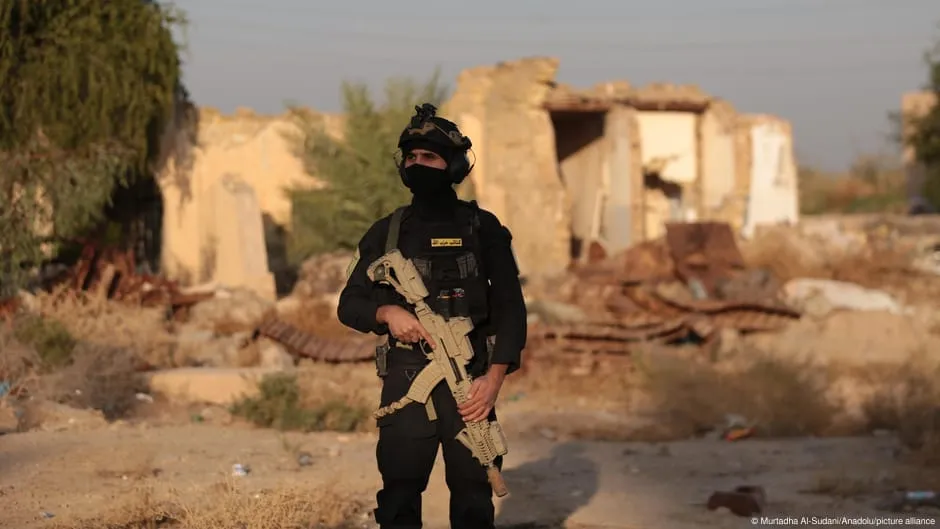
Iraqi militia standoff in Jurf al-Sakhar: State vs. Kataib Hezbollah
The Iraqi militia standoff in Jurf al-Sakhar has escalated into one of the most significant confrontations between the central government and Iran-allied armed groups in decades. Iraqi security forces have surrounded the area to enforce a government mandate to disarm Kataib Hezbollah, a prominent Shiite militia. This tension follows a government report alleging the group has smuggled hundreds of millions of dollars in state-owned oil since 2021. Prime Minister Ali al-Zaidi has set a June 2027 deadline to bring all weapons under state control, facing intense resistance from militia factions that control significant territory and economic resources.
November 21, 2026
5 min read
Source: ASHENVOW
The confrontation at Jurf al-Sakhar
Iraqi security forces have moved to encircle the Jurf al-Sakhar region to challenge the autonomy of the Kataib Hezbollah militia. This area, located approximately 50 kilometers south of Baghdad, has been under militia control for roughly 12 years, effectively barring government troops and news media from entry. The standoff follows an ultimatum from Prime Minister Ali al-Zaidi demanding that the group vacate the territory by November 20, 2026. Kataib Hezbollah rejected this demand, with a spokesperson stating the group would not withdraw "not even over our dead bodies."
The escalation represents a critical test of the Iraqi state's ability to assert authority over the Popular Mobilization Forces (PMF), a collective of armed groups that fought against the Islamic State (IS). While the PMF includes various factions, Kataib Hezbollah maintains close ties to Iran. The current friction is driven by the government's attempt to reclaim control over strategic assets and enforce a national disarmament timeline.
Historical context of the region
Jurf al-Sakhar's landscape changed significantly following the rise of the Islamic State in 2014. Previously home to an estimated 89,000 residents, much of the population—primarily Sunni Muslims—was displaced during the conflict. Following the fight against IS, Kataib Hezbollah entered the area and established a militarized presence. The militia even renamed the area from Jurf al-Sakhar ("rocky bank") to Jurf al-Nasr ("bank of victory"). For over a decade, the region has been subject to various allegations, including the existence of secret prisons, mass graves, and facilities for manufacturing drones and weapons.
Economic drivers and oil smuggling allegations
A central catalyst for the current standoff is the allegation of large-scale economic theft by militia elements. According to an early November report from the Iraqi government, Kataib Hezbollah has been involved in smuggling hundreds of millions of dollars' worth of state-owned oil by siphoning it from pipelines located around Jurf al-Sakhar since 2021. Although Kataib Hezbollah has denied these claims, the report prompted the government to make several high-profile arrests.
Public sentiment in Iraq appears to support the Prime Minister's intervention. Social media commentary indicates widespread belief among citizens that national oil resources are being diverted to benefit foreign interests rather than the Iraqi state. This economic dimension transforms the standoff from a purely security-based issue into a struggle over the nation's sovereign wealth and infrastructure protection.
| Issue | Government Allegation / Position | Militia Response |
|---|---|---|
| Oil Smuggling | Hundreds of millions of dollars siphoned since 2021 | Categorical denial |
| Territorial Control | Demand for withdrawal by Nov 20, 2026 | Refusal to withdraw |
| Security Command | Integration into federal security structures | Rejection of new security plans |
Political complexities and the role of the Coalition Framework
The standoff is complicated by the fact that Prime Minister Ali al-Zaidi was nominated by the Coalition Framework (CF), a political bloc that represents many of the PMF's interests in parliament. Kataib Hezbollah's own political party, Harakat Huqooq, is a member of this same framework. This creates a paradoxical situation where the head of government is attempting to disarm groups that are part of his own political support base.
Despite these ties, reports suggest growing fractures within the political landscape. Iraqi news media have noted divisions within both the CF and Kataib Hezbollah itself regarding the handling of the Jurf al-Sakhar crisis. According to Amwaj Media, some senior officials suggest a gradual transition where parts of the territory are handed to federal forces, while some Kataib Hezbollah members have expressed a preference for handing control to other PMF brigades rather than directly to state security forces.
The risk of asymmetric conflict
While the Iraqi military possesses superior resources compared to Kataib Hezbollah, experts warn that a conventional victory is unlikely to be simple. Hayder al-Shakeri, a research fellow at Chatham House, noted that the military could potentially take the area if political and security institutions remained united. However, he cautioned that Kataib Hezbollah does not need a conventional victory to succeed; instead, it can exert influence through asymmetric attacks, political pressure, and its deep-seated networks within the Iraqi state apparatus.
International pressure and disarmament deadlines
The Iraqi government is operating under significant external pressure to centralize its security forces. The United States has warned Iraq that it could face designation as a state sponsor of terrorism if it fails to meet its objectives for disarming militias. This international scrutiny is heightened by the ongoing geopolitical tensions involving the US, Israel, and Iran, which place Iraq in a difficult position as it attempts to balance relationships with both US allies and Iranian-backed factions.
Prime Minister al-Zaidi has established a firm deadline of June 2027 to bring all weapons under state control. This timeline is intended to signal a shift toward state sovereignty, yet the Jurf al-Sakhar incident serves as a litmus test for whether this goal is achievable or merely rhetorical. The outcome will likely dictate how other militia factions approach their own territorial and economic autonomies.
Potential outcomes and the path to compromise
Recent reports suggest a possible de-escalation. According to three anonymous officials cited by Reuters, all parties may have reached an agreement allowing government forces to enter Jurf al-Sakhar on Friday, November 21, 2026. Such a compromise would prioritize the avoidance of direct violence, though it may not fully satisfy the government's original goal of complete militia removal.
The long-term impact of the standoff depends on the nature of the eventual security command. Ulf Laessing of the Konrad Adenauer Foundation (KAS) suggests that even if the compromise is imperfect, it remains a vital political signal. The core question remains whether the state can break the monopoly of specific factions over territory and economic activity. If the standoff results in a mere redistribution of armed influence—where one PMF faction replaces another—the fundamental problem of militia autonomy will persist. However, if it allows for regular state forces to protect oil infrastructure and provides a path for displaced residents to return, it could represent a genuine step toward state authority.



