
Gelephu Mindfulness City: Bhutan's ambitious plan for growth
Gelephu Mindfulness City is a transformative economic project designed to revitalize Bhutan's economy and curb youth migration. On November 1, 2026, over 40,000 volunteers constructed 108 Buddhist stupas along a 12km riverbank to mark the project's progress. This massive spiritual and structural undertaking involved nearly a quarter of Bhutan's population, approximately 200,000 attendees. The initiative seeks to integrate sustainable business, green technology, and digital assets into a special economic zone. This article explores the spiritual foundations, economic challenges, and technological ambitions of the Gelephu project.
November 8, 2026
5 min read
Source: ASHENVOW
How did the construction of 108 stupas mark the Gelephu project?
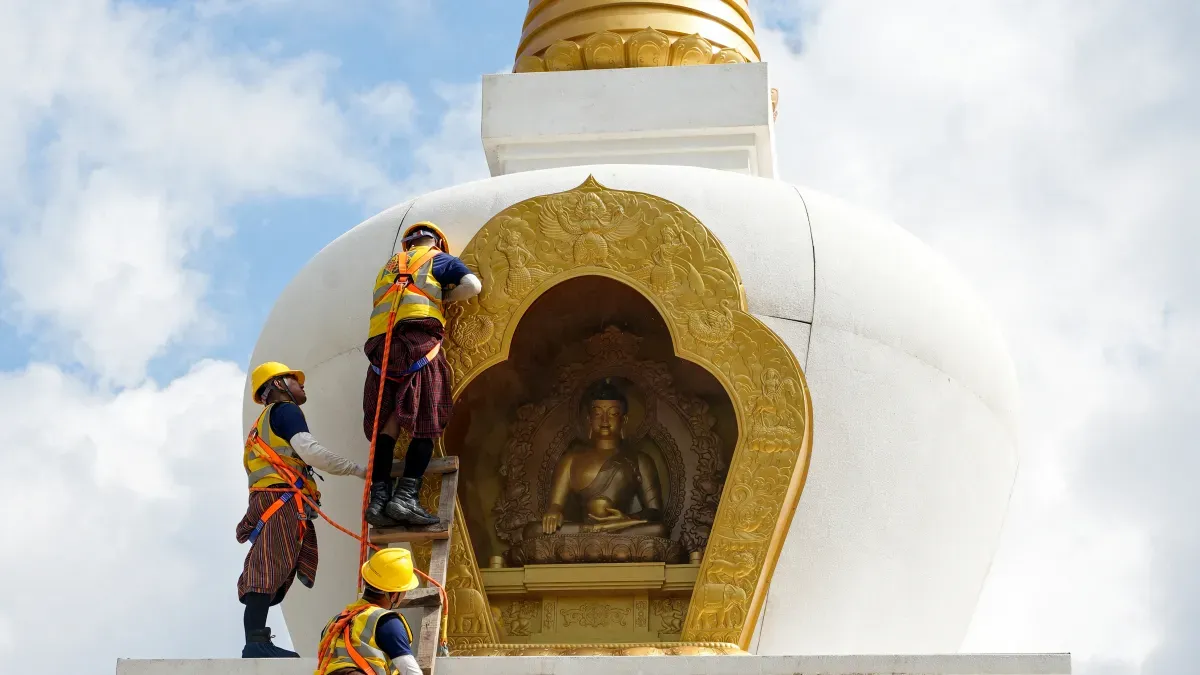
The rapid construction of 108 Buddhist stupas on November 1, 2026, served as a monumental physical manifestation of the Gelephu Mindfulness City vision. These 15-metre-tall sacred monuments were erected along a 12km stretch of riverbank near the Indian border. The task was completed in a single day by more than 40,000 volunteers who began their work after midnight. According to officials, the stupas represent a permanent prayer made of stone and earth.
The number 108 holds deep spiritual significance in Buddhism, which is the primary religion practiced throughout the Himalayan kingdom. The scale of the event was unprecedented; officials reported that approximately 200,000 people attended the ceremony. This figure represents nearly one-fourth of Bhutan's total population. The successful completion of the task provided a moment of national unity and spiritual reinforcement for the ambitious urban development project.
The spiritual significance of the ceremony
For the Bhutanese people, the construction was more than a civil engineering feat; it was a collective act of devotion. King Jigme Khesar Namgyel Wangchuck addressed the crowd, expressing his initial apprehension regarding the logistical difficulty of raising 108 structures in such a short timeframe. He noted that the successful outcome was a source of great gratitude for the monarchy and the nation.
What economic challenges is Bhutan attempting to solve?
Bhutan is utilizing the Gelephu Mindfulness City to address critical demographic and economic vulnerabilities that threaten its long-term stability. The nation currently faces a complex set of pressures, including rising unemployment rates and declining birth rates. Perhaps most significantly, Bhutan is struggling with the mass migration of its skilled workforce, as young professionals seek better opportunities abroad.
The Gelephu project, established by royal charter in 2024, is designed to act as a "vibrant economic hub" to counter these trends. By creating a specialized zone, the government hopes to attract diverse sectors including:
- Sustainable business and green technology
- International tourism and financial services
- Advanced education and specialized training
Currently, Gelephu is a small town with a population of roughly 10,000. Through this project, the government intends to transform the southern region into a major driver of national prosperity, providing the necessary infrastructure and opportunities to persuade the younger generation to remain in the country.
How will the city integrate technology and cryptocurrency?
The Gelephu Mindfulness City is not merely a traditional urban development; it is a high-tech initiative linked to Bhutan's growing interest in digital assets. The kingdom has already established a footprint in the cryptocurrency sector by using its surplus hydropower to mine Bitcoin. The government intends to leverage these digital assets to provide financial support and liquidity for the city's development.
While some analysts have expressed skepticism regarding whether Bhutan can attract the massive investment required to realize such a vision, the project has already secured significant high-profile interest. Notably, Gautam Adani, the Indian billionaire and head of a major ports-to-power conglomerate, joined the project as a founding member in January. This involvement suggests a growing confidence in the project's viability among international investors.
Infrastructure and connectivity plans
To support this technological and economic shift, Bhutan is investing heavily in regional connectivity. A key component of the Gelephu strategy involves linking the site to India's extensive rail network in the neighbouring state of Assam. Furthermore, the development includes the construction of an international airport, which is currently slated to become operational in 2029. These transport links are essential for transforming the landlocked nation into a connected hub for trade and digital commerce.
What is the relationship between Gross National Happiness and economic growth?
The Gelephu Mindfulness City represents a unique attempt to harmonize Bhutan's traditional philosophy of Gross National Happiness (GNH) with modern industrial requirements. While most nations prioritize GDP, Bhutan has long been recognized for its policy of prioritizing spiritual and environmental well-being alongside economic metrics. The "Mindfulness" aspect of the new city is a direct extension of this philosophy.
The project is designed by Danish architects to ensure that the rapid economic expansion does not come at the cost of the country's cultural or environmental integrity. By focusing on "mindfulness," the city aims to create a workspace and living environment that respects Buddhist values while fostering innovation. This approach seeks to prove that a nation can participate in the global digital economy—including cryptocurrency and green tech—without losing its unique cultural identity.
Frequently asked questions
What is the primary goal of Gelephu Mindfulness City?
The primary goal is to stimulate Bhutan's economic growth and prevent the migration of skilled youth. By creating a special economic zone focused on sustainable business, green technology, and financial services, the government aims to build a vibrant hub that offers modern career opportunities within the country.
Why was the number 108 chosen for the stupas?
The number 108 is considered sacred in Buddhism, which is the dominant religion in Bhutan. Constructing 108 stupas serves as a spiritual foundation for the city, acting as a permanent physical form of prayer to bless the new economic and social endeavor.
How is Bhutan involved in cryptocurrency?
Bhutan utilizes its surplus hydropower to mine Bitcoin, integrating renewable energy with digital asset production. The government plans to use these digital assets to help fund and support the development of the Gelephu Mindfulness City project.
Who is involved in the funding and design of the city?
The project was conceived by King Jigme Khesar Namgyel Wangchuck and is being designed by Danish architects. Additionally, Indian billionaire Gautam Adani has joined the project as a founding member, providing a significant signal of international investment interest.
Where is the Gelephu Mindfulness City located?
The city is located in southern Bhutan, near the Indian border. It is situated approximately 240km south of the capital, Thimphu, and is positioned to benefit from future connections to India's rail and transport networks.
Key takeaways
- Over 40,000 volunteers built 108 stupas in one day to mark the Gelephu project.
- The city aims to combat rising unemployment and the migration of skilled Bhutanese workers.
- Bhutan plans to use cryptocurrency and hydropower to support the city's economic development.
- An international airport is scheduled to open in 2029 to enhance regional connectivity.
The future of Bhutan's economic landscape
The Gelephu Mindfulness City stands as a bold experiment in combining spiritual tradition with 21st-century economic necessity. By attempting to bridge the gap between Gross National Happiness and the digital economy, Bhutan is seeking a unique path to prosperity. The success of this project will depend on its ability to attract sustained international investment and successfully integrate its technological ambitions with its cultural heritage. If successful, it could provide a global model for sustainable, values-driven urban development.



