
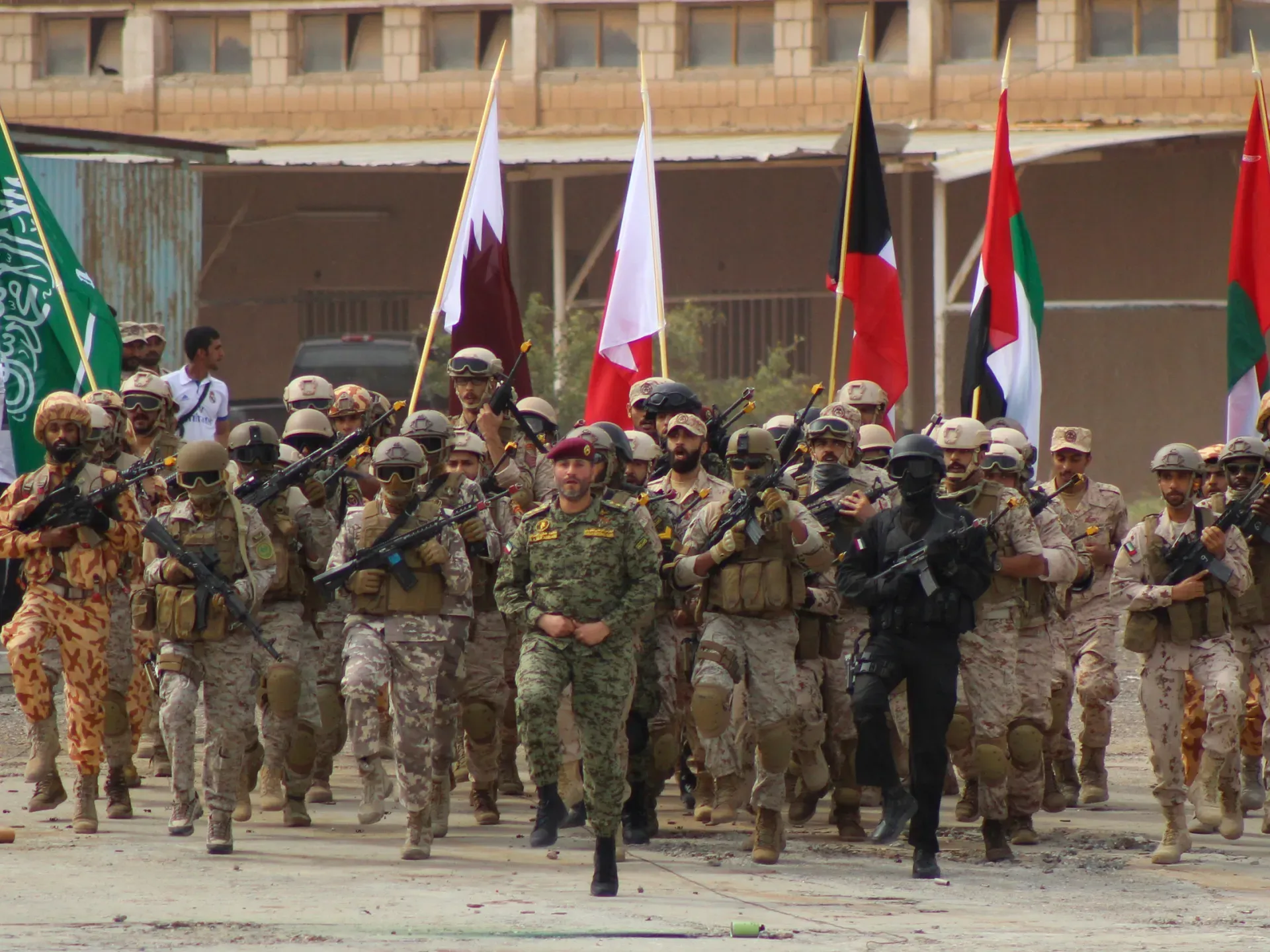
GCC military command in Kuwait: Establishing an advanced headquarters
The Gulf Cooperation Council (GCC) has agreed to establish an advanced headquarters for its Unified Military Command in Kuwait, including the allocation of appropriate military forces. This decision, announced following the 23rd meeting of the GCC’s Joint Defence Council on November 10, 2026, aims to strengthen regional defence coordination. The move responds to heightened security risks stemming from the US-Israel war on Iran and persistent Houthi attacks on Saudi Arabia. By positioning a command post in Kuwait, the six member states—Bahrain, Kuwait, Oman, Qatar, Saudi Arabia, and the United Arab Emirates—seek to bolster collective deterrence and protect critical energy infrastructure.
November 18, 2026
4 min read
Source: ASHENVOW
Strategic positioning of the new Kuwaiti headquarters
The GCC will establish a forward headquarters in Kuwait to serve as a command post positioned closer to potential regional threats. While the specific number of troops and the exact types of forces to be assigned have not been disclosed, the move signifies a permanent military presence at the northern end of the Gulf. This structural addition complements the existing Unified Military Command headquarters in Riyadh, which opened in 2021.
Muhanad Seloom, a nonresident fellow at the Middle East Council on Global Affairs, noted that placing the command in Kuwait provides a unified presence at the top of the Gulf. This positioning is particularly relevant for Kuwait, which has historically maintained a moderate stance toward Iran despite facing direct security challenges. The presence of a unified command in Kuwait serves two primary functions:
- Deterrence against Iran-aligned groups: It addresses threats from armed groups operating from Iraq that have targeted Gulf states with drones.
- Regional reassurance: It signals to both Iran and Iraq that the GCC is prepared for various security scenarios.
Evolution of the Unified Military Command structure
The Unified Military Command was originally established in 2013 to facilitate joint operations and collective defence among the six member states. The decision to add a forward headquarters in Kuwait represents an expansion of this 2013 framework rather than a replacement of existing structures. The bloc already operates the Peninsula Shield force, which has existed for decades, but the new Kuwaiti facility aims to create a more integrated and geographically distributed command architecture.
Impact of the US-Israel war on Iran
The decision to formalize a more robust command structure follows the regional instability triggered by the US-Israel war on Iran, which began on February 28. During this conflict, Gulf states—many of which host significant United States military installations—were subjected to missile and drone attacks originating from Iran. These attacks disrupted vital shipping lanes and flight paths, directly threatening the oil and gas exports that underpin the regional economy.
Although US President Trump stated on November 10, 2026, that further military action against Iran was not necessary at that moment, the security environment remains volatile. A US naval blockade persists, and maritime traffic through the Strait of Hormuz has yet to return to pre-conflict normalcy. According to Muhanad Seloom, the new headquarters is not necessarily a response to an imminent strike, but rather a component of a long-term GCC strategy to build indigenous deterrents. He observed that the regional security order has shifted, with GCC capitals increasingly emphasizing the need for their own defensive capabilities.
Addressing Houthi aggression and Yemen instability
The GCC's military expansion is also a direct response to the intensifying conflict in Yemen involving the Iran-aligned Houthi movement, also known as Ansar Allah. While a United Nations-brokered truce in 2022 provided a period of relative calm, recent months have seen a resurgence of hostilities. The GCC leadership has explicitly condemned Houthi attacks on Saudi Arabia, labeling them a violation of sovereignty and Islamic sanctity.
The severity of the threat was highlighted by a Houthi attack on Riyadh’s King Khalid International Airport on October 10, which resulted in 14 deaths and more than 300 injuries. In response to such volatility, GCC Secretary-General Jasem Mohamed Albudaiwi stated that the assaults represent a blatant transgression against the security of the Kingdom. The new command structure in Kuwait is intended to provide a more coordinated response to these asymmetric threats, such as drone and missile barrages, that bypass traditional border defences.
The interplay of GCC, bilateral, and US security alliances
The establishment of the Kuwaiti headquarters does not exist in isolation but rather adds a layer to a complex web of overlapping security arrangements in the Middle East. The GCC framework now operates alongside several recent bilateral and trilateral agreements designed to enhance regional stability.
| Agreement / Treaty | Participants | Core Principle |
|---|---|---|
| GCC Unified Military Command | Bahrain, Kuwait, Oman, Qatar, Saudi Arabia, UAE | Collective defence and joint operations coordination |
| Mecca Joint Defence Agreement (August 2026) | Saudi Arabia, Pakistan, Turkiye | An attack on one is considered an attack on all three |
| Saudi-Pakistan Mutual Defence Treaty (2025) | Saudi Arabia, Pakistan | Bilateral mutual defence obligations |
Despite the growth of these indigenous frameworks, analysts suggest that the GCC is not seeking to decouple from the United States. Albert Vidal, a Gulf and Middle East analyst at the International Institute for Strategic Studies, stated that the announcement does not imply a shift away from Washington. He argued that the US would likely support increased GCC cooperation, as information sharing and direct coordination among Gulf states ultimately enhance overall military effectiveness.
A shift toward regional autonomy
While the US remains a primary security provider, the rhetoric from GCC capitals suggests a transition toward greater strategic autonomy. Muhanad Seloom characterized the move not as a reaction to a failure of US protection, but as a "wake-up call" for the GCC to take more direct responsibility for its own security architecture. By developing a permanent, unified command structure, the GCC is moving toward a model where regional powers can manage immediate threats through integrated local command rather than relying solely on external intervention.



