
Colombian president museum purge: A cultural counterrevolution?
The Colombian president museum purge has begun in Bogota, as President Abelardo de la Espriella initiates a campaign to remove exhibits he labels as promoting 'atheist social communism.' Following his announcement, the National Museum has seen the removal of displays regarding social movements, feminist activism, and LGBTQ history. This move has triggered widespread protests by students and civil rights groups in downtown Bogota. The administration's actions represent a broader ideological shift aimed at redesigning the nation's cultural narrative. This article examines the details of the purge, the government's justifications, and the parallels drawn to US political strategies.
October 27, 2026
6 min read
Source: ASHENVOW
What is driving the Colombian president museum purge?
President Abelardo de la Espriella has officially launched what he describes as a 'cultural counterrevolution' aimed at purging national institutions of perceived leftist influence. The conservative leader, who is an ally of US President Donald Trump, stated his intention is to prevent cultural spaces from being dominated by what he terms 'atheist social communism.' This ideological offensive is not limited to a single institution; the government is actively seeking to reshape the curatorial standards of the country's entire museum landscape.
The administration's stated goal is to dismantle what they perceive as a radicalized cultural establishment. By targeting these institutions, de la Espriella aims to re-center Colombian identity around more traditional, conservative values. This approach marks a significant departure from previous administrations that focused on pluralism and the inclusion of diverse social histories.
The scope of the administrative review
According to Culture Minister Paola Holguin, the government is not merely focusing on the National Museum. The Ministry of Culture is currently reviewing and redesigning exhibitions and curatorial practices across various museums under its jurisdiction. This suggests a systemic attempt to align all state-funded cultural heritage with the current administration's political framework.
Which exhibits have been removed from the National Museum?
Dozens of exhibits have already been taken down from the National Museum in Bogota, specifically those that addressed the history of social movements and political violence in Colombia. The removals have targeted several sensitive areas of the nation's sociological development, including feminist activism and LGBTQ rights movements. These displays, which previously provided context for the country's social evolution, are being replaced or suppressed under the new mandate.
Beyond the museum walls, the government has also moved to alter historical markers. The Ministry of Foreign Affairs recently renamed a courtyard that previously honored an Indigenous leader. This decision was explicitly framed as part of the president's campaign against 'woke' ideology, signaling that the purge extends to public spaces and the physical symbols of national history.
How are citizens and activists responding to the changes?
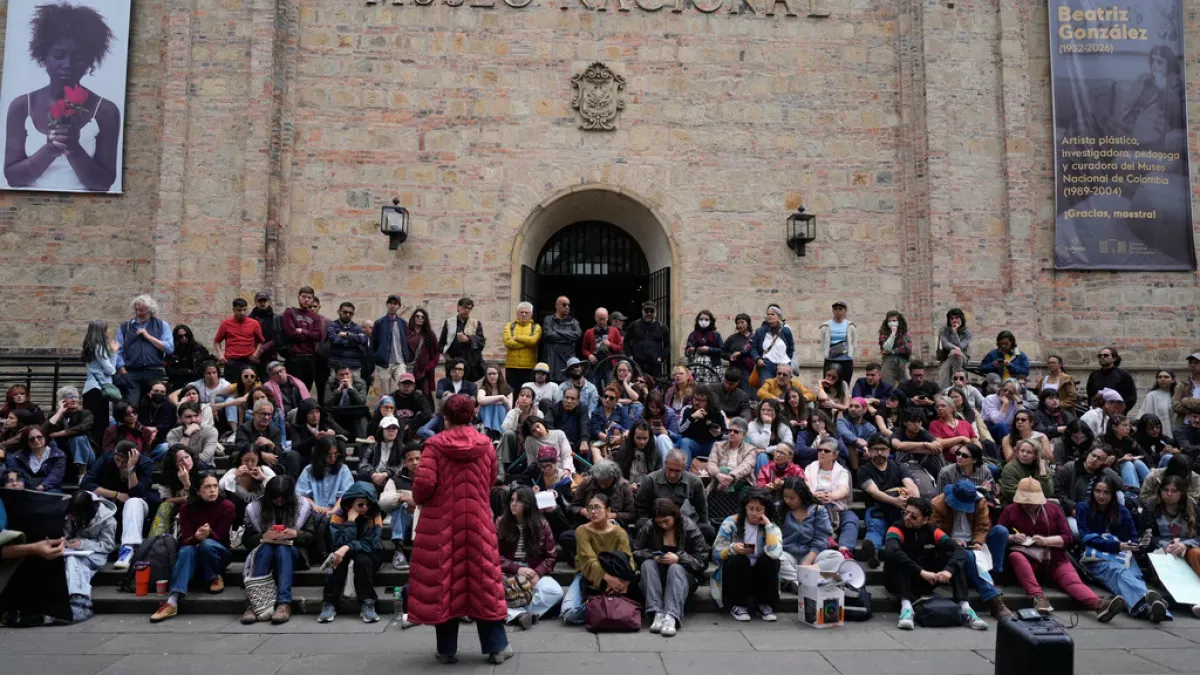
Protests have erupted in Bogota, with demonstrators gathering outside the National Museum to voice opposition to what they call state-sponsored censorship. On October 21, 2026, university students held outdoor classes in front of the museum as a form of protest, while riot police were deployed to guard the entrance. Critics argue that the government is attempting to erase the lived experiences of marginalized groups to create a sanitized version of history.
The backlash is characterized by several key concerns from the academic and activist communities:
- Erasure of Identity: Students and historians argue the purge promotes a narrow vision of Colombia as exclusively white, Catholic, and Spanish-speaking.
- Exclusionary Narratives: Activists claim the removal of Black, Indigenous, and LGBTQ history effectively erases these communities from the national consciousness.
- Historical Revisionism: Civil rights groups warn that the government is actively rewriting history to suit a specific political agenda.
Azul Riascos, a history student, expressed the sentiment of many protesters, stating that the government's attempt to erase these parts of history is 'outrageous.' The movement suggests a growing divide between the state's ideological direction and the diverse reality of the Colombian population.
Is there a connection to United States political trends?
Observers have noted significant parallels between de la Espriella's actions and the political strategies employed by Donald Trump in the United States. Gimena Sanchez-Garzoli, the director for the Andes at the Washington Office on Latin America, suggests that the Colombian government is adopting US-style narratives to justify its cultural interventions. This includes the use of terms like 'woke' to delegitimize existing social and cultural frameworks.
The ideological alignment between these two leaders extends beyond rhetoric. Sanchez-Garzoli notes that the cooperation between Trump and allied Latin American governments on security and counternarcotics often carries a shared ideological dimension, suggesting a coordinated approach to regional politics.
Comparison of cultural intervention strategies
The methods used in Colombia mirror several recent developments in the US political landscape. For example, the White House in the US has previously targeted the Smithsonian Institution, branding leaders of the National Museum of American History as 'radical activists.' This international trend of targeting museums as battlegrounds for 'culture wars' is becoming a defining feature of conservative governance in both North and South America.
What are the implications for Colombian national identity?
Political scientists and anthropologists suggest that the government's actions may be creating a conflict where none previously existed in such a structured form. Estefania Cardozo, a political scientist, observed that the administration appears to be 'inventing' a cultural battle to justify the erasure of identities that are already deeply embedded in the social fabric of the country. The implication is that while the government can remove a plaque or an exhibit, the underlying social identities remain.
Anthropologist Arturo Sanabria has described these moves as a form of 'neocolonial intervention,' arguing that the importation of foreign political narratives—specifically regarding 'terrorism' and 'wokeness'—is being used to reshape Colombian society. This suggests that the purge is not just a local political shift, but part of a larger, globalized ideological struggle that seeks to standardize conservative values across borders.
FAQ: Colombian Museum Purge
Why is the Colombian government removing museum exhibits?
President Abelardo de la Espriella is leading a 'cultural counterrevolution' to remove exhibits he claims promote 'atheist social communism.' The administration aims to redesign cultural institutions to align with conservative values and combat what they describe as 'woke' ideology within the nation's museums.
What types of history are being removed?
The removals focus on the history of social movements, including feminist activism, LGBTQ rights, and Colombia's history of political violence. Additionally, the government is targeting Indigenous history, as seen in the renaming of a courtyard previously dedicated to an Indigenous leader.
How has the public reacted to these removals?
The actions have sparked significant protests in Bogota, led by students, artists, and civil rights groups. Demonstrators have accused the government of censorship and attempting to erase the diverse identities—including Black, Indigenous, and LGBTQ communities—that constitute Colombian history.
Is this movement related to US politics?
Yes, analysts have noted that President de la Espriella is an ally of Donald Trump and is adopting similar political narratives. This includes the use of 'woke' terminology and the targeting of cultural institutions, similar to the criticisms leveled against the Smithsonian Institution in the United States.
What is the role of the Ministry of Culture in this process?
The Ministry of Culture, led by Paola Holguin, is actively reviewing and redesigning exhibitions and curatorial practices across various museums. This indicates that the purge is a coordinated, state-led effort to transform the country's entire cultural and historical presentation.
Key takeaways
- President de la Espriella has launched a 'cultural counterrevolution' to remove 'communist' influences from museums.
- Exhibits on feminist, LGBTQ, and social movement histories have been removed from the National Museum.
- Protests by students and activists have broken out in Bogota against perceived government censorship.
- The government is using US-style 'woke' narratives to justify cultural and historical redesigns.
Conclusion
The purge of Colombia's National Museum marks a pivotal moment in the country's struggle over historical narrative and national identity. By framing cultural diversity as a threat to national stability, the de la Espriella administration is attempting to centralize control over the nation's past. While the government views this as a necessary defense against radical ideologies, critics see it as a dangerous attempt at censorship that ignores the country's pluralistic reality. As the administration expands its review to other institutions, the tension between state-mandated history and the lived experiences of Colombian citizens is likely to intensify.



