
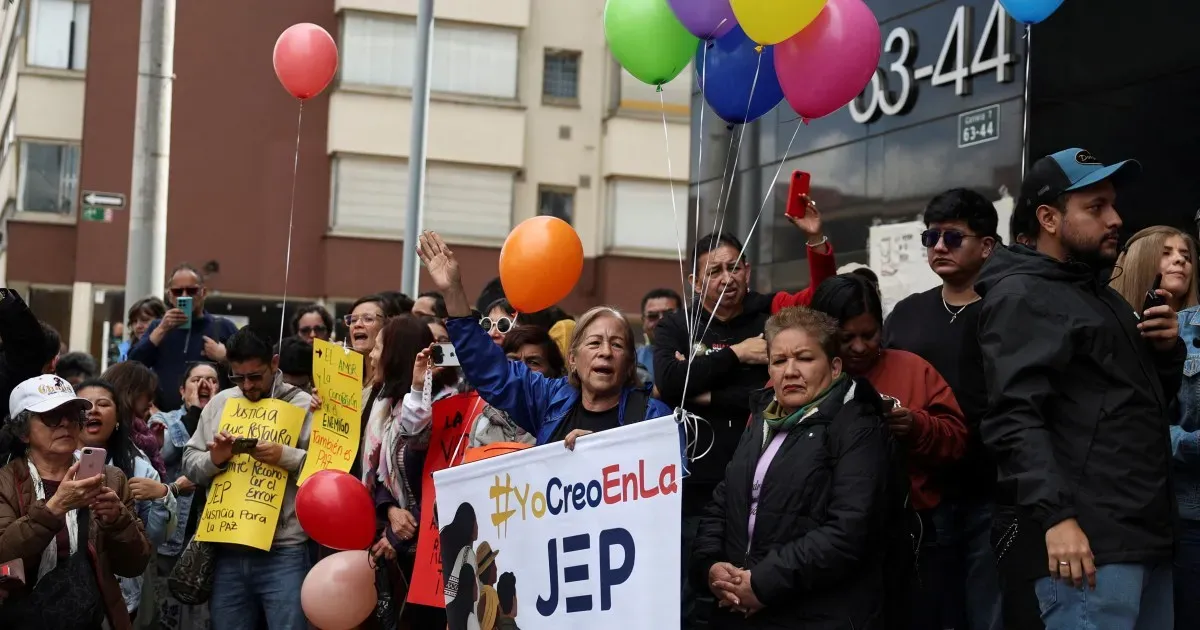
JEP budget cuts in Colombia: Impact on human rights court
JEP budget cuts proposed by President Abelardo de la Espriella threaten the stability of Colombia's transitional justice system. The administration plans to reduce the Special Jurisdiction for Peace (JEP) budget by approximately 181 billion Colombian pesos, or $57 million, for 2027. This move comes alongside legislative efforts to potentially dissolve the court by March 2028. While the government cites public debt management as the primary driver, critics argue the cuts target the court's ability to investigate war crimes and provide closure to victims of the six-decade-long internal conflict.
November 8, 2026
6 min read
Source: ASHENVOW
What are the proposed JEP budget cuts and legislative changes?
The Colombian administration under President Abelardo de la Espriella has announced significant financial reductions for the Special Jurisdiction for Peace (JEP), targeting a decrease of roughly 181 billion Colombian pesos ($57 million) in the 2027 budget. Beyond mere fiscal tightening, the political landscape in Bogota is shifting toward a structural overhaul of the transitional justice system.
A Senate committee has advanced a bill that aims to eliminate the JEP entirely by March 2028. If passed, this legislation would transfer the responsibilities currently held by the specialized court to the country's general judicial system. This represents a fundamental shift from the specialized framework established during the 2016 peace negotiations between the government and the Revolutionary Armed Forces of Colombia (FARC).
The scale of the 2027 budget
While the cuts to JEP are substantial, the broader 2027 budget proposed by de la Espriella is the largest in Colombian history, totaling approximately 634 trillion pesos ($200 billion). The President has defended the specific reductions to JEP as a necessary component of a broader strategy to manage a national public debt that currently exceeds $370 billion. He has framed these decisions as a duty to allocate limited state resources to a justice system that serves the entire population rather than specific entities.
Why is President de la Espriella targeting the JEP?
President Abelardo de la Espriella has frequently voiced opposition to the JEP, characterizing the institution as an ineffective body that lacks impartiality. His criticisms focus on the speed of the court's proceedings and its perceived ideological leanings regarding the victims and perpetrators of the Colombian conflict.
In public statements and media appearances, the President has leveled several specific accusations against the court:
- Alleged bias: He has claimed the court is overly lenient toward rebel groups while being disproportionately focused on investigating military personnel.
- Inefficiency: He has criticized the institution for failing to deliver timely justice and fulfilling its original mandates.
- Persecution: In an interview with the radio program Recap Blu, he accused the JEP of "persecuting the heroes of the homeland" while simultaneously protecting guerrillas accused of crimes against humanity.
These criticisms suggest that the budgetary pressure is not solely a matter of fiscal austerity but is also part of a broader political critique of the 2016 peace process architecture.
How would these cuts impact victims of the conflict?
Victims and human rights advocates warn that the reduction in funding will directly diminish the court's capacity to conduct field investigations and locate missing persons. For many families, the JEP is the only institution capable of providing the truth regarding the fate of loved ones lost during the decades of internal warfare.
The impact on victims is expected to manifest in several critical areas:
- Field investigations: Reduced resources mean fewer missions to rural areas to locate remains or identify execution sites.
- Humanitarian personnel: A smaller budget limits the number of experts and staff available to assist families in their search for answers.
- Witness cooperation: Legal experts warn that shrinking the budget could cripple programs designed to encourage witnesses to come forward, which is essential for solving cold cases.
Ana Maria Rodriguez, a lawyer representing conflict victims, has described the potential outcome of these cuts as "absolutely disastrous." She notes that for many perpetrators, the JEP is the only mechanism through which they have ever faced legal scrutiny, and weakening it could lead to widespread impunity.
What is the legal and international significance of the JEP?
The JEP serves as a cornerstone of the 2016 peace agreement, designed to balance the need for justice with the necessity of ending the conflict. Its unique mandate allows for alternative sentencing, such as community service and rehabilitation, in exchange for full cooperation and truth-telling from former combatants.
This model has drawn significant international attention and scrutiny. While the President views these leniency measures as a failure of justice, proponents argue they are essential for the peace process to function. The court has successfully convicted high-ranking FARC leadership, demonstrating its ability to hold even the most powerful actors accountable.
International intervention and concerns
The potential dismantling of the JEP has prompted domestic lawmakers to seek external support. More than 20 members of the Colombian Congress have signed an open letter to the International Criminal Court (ICC), requesting assistance to protect the integrity of ongoing investigations. Because the ICC shares a similar mandate regarding war crimes, there is a fear that if the JEP fails, the burden of justice will fall on international bodies or be lost entirely. Lawmakers expressed concern that the budget approvals would jeopardize the execution of sentences and the overall stability of trials for crimes under the court's jurisdiction.
What are the broader political implications for Colombian security?
The moves against the JEP are viewed by some analysts as part of a wider shift toward a more hardline security doctrine in Colombia. Alberto Yepes, a spokesman for the Colombia-Europe-United States Coordination Group, suggests that the administration's approach mirrors security models used in El Salvador and Ecuador.
In these models, police and military forces are granted significantly expanded powers. Critics argue that by weakening the judicial oversight provided by the JEP, the executive branch may be attempting to insulate military leaders from future prosecution for state-linked crimes. This creates a tension between the government's pursuit of increased domestic security and the international community's demand for accountability and the rule of law.
Frequently asked questions
What is the JEP?
The Special Jurisdiction for Peace (JEP) is Colombia's transitional justice court, established in 2016 as part of the peace deal with the FARC. It is tasked with investigating, prosecuting, and sentencing those responsible for war crimes and other serious human rights violations committed during the country's internal conflict.
How much is the proposed budget cut?
The administration of President Abelardo de la Espriella has proposed a reduction of approximately 181 billion Colombian pesos, which is roughly equivalent to $57 million, for the JEP's 2027 budget. This is part of a larger effort to manage the nation's $370 billion public debt.
Why does the President oppose the JEP?
President de la Espriella argues that the JEP is slow, ineffective, and biased. He has specifically accused the court of being too lenient on guerrilla fighters while unfairly targeting members of the Colombian military, whom he refers to as "heroes of the homeland."
Will the JEP be abolished?
There is a legislative movement in the Colombian Senate to eliminate the JEP by March 2028. A proposed bill would transfer the court's current functions to the general judicial system, effectively ending the specialized transitional justice framework.
How do victims benefit from the JEP?
Victims benefit through the court's ability to provide truth and location data regarding missing persons. Through cooperation programs, the JEP helps families find the remains of loved ones and provides information about the circumstances of their deaths, which the traditional criminal justice system often failed to do.
Key takeaways
- The de la Espriella administration proposes a 181 billion peso cut to the JEP budget for 2027.
- A Senate bill seeks to dissolve the JEP and transfer its duties to the general court system by 2028.
- President de la Espriella claims the court is biased against the military and too lenient on rebels.
- Human rights advocates warn that budget cuts will reduce field missions and increase impunity for war crimes.
- Colombian lawmakers have appealed to the International Criminal Court for support in protecting JEP investigations.
Conclusion
The proposed budgetary and legislative challenges facing the Special Jurisdiction for Peace represent a pivotal moment for Colombia's peace process. While President de la Espriella frames these actions as necessary fiscal discipline to manage a massive national debt, the potential consequences extend far beyond economics. For the thousands of families seeking truth about the 450,664 lives lost in the conflict, the JEP is a vital lifeline. The tension between the government's hardline security objectives and the international community's demand for transitional justice will likely determine the future stability of the Colombian state and its commitment to human rights.



