
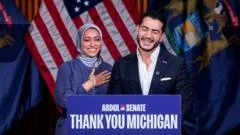
Abdul El-Sayed Michigan Senate win: First Muslim US Senator
Abdul El-Sayed Michigan Senate win marks a historic shift in American politics as the Democrat becomes the first Muslim to serve in the US Senate. Following a high-stakes midterm contest in the battleground state of Michigan, El-Sayed defeated Republican Mike Rogers. The victory follows a campaign defined by intense inter-party disputes and significant outside spending. This win signals a growing influence for the Democratic left and provides a major milestone for Arab-American and Muslim voters. This article examines the election results, the campaign's controversial nature, and the broader political implications for the US Senate.
November 8, 2026
5 min read
Source: ASHENVOW
How did Abdul El-Sayed win the Michigan Senate seat?
Abdul El-Sayed secured victory by running on a progressive platform that successfully tapped into grassroots frustrations regarding economic inequality and foreign policy. The 42-year-old former public health administrator campaigned heavily on promises of universal health care and the implementation of a wealth tax targeting billionaires. His slogan, "Money out of politics, money in your pocket and Medicare for all," resonated with a voter base looking for systemic change.
The race was characterized by its difficulty, as the seat—previously held by retiring Democrat Gary Peters—was identified by analysts as one of the most competitive in the midterm elections. El-Sayed faced significant opposition from Republican candidate Mike Rogers, who was backed by President Donald Trump. Rogers' campaign attempted to frame El-Sayed through a lens of ideology and religion, labeling him a communist and criticizing his faith and his stance on Israel.
The impact of campaign rhetoric and outside spending
Throughout the election cycle, El-Sayed was subjected to intense scrutiny and attacks. His opponents utilized significant outside spending to favor Rogers and his former Democratic primary rival, Haley Stevens. These attacks often included baseless associations with terrorism and critiques of his religious background. Despite this, El-Sayed maintained an unapologetic stance, focusing on the rising costs of living and the need to reform Washington's relationship with political money.
What was the role of internal Democratic tension in the race?
Internal party disputes played a central role in the Michigan contest, specifically involving the unexpected endorsement of Republican Mike Rogers by Haley Stevens. Stevens, who had been El-Sayed's primary rival, endorsed the Republican candidate just days before the election. This move caused significant friction within the Democratic Party, with leadership describing the endorsement as a "despicable betrayal." The fallout was immediate, reportedly leading to the mass resignation of Stevens' staff.
The endorsement created confusion among the electorate. While some voters questioned if the move was driven by personal anger, others were left unsure of how to interpret the shift in political alignment. El-Sayed, however, attempted to maintain focus on his own platform, telling reporters that he did not dwell on Stevens' actions and that such internal drama did not change the core issues facing voters.
Why is this victory significant for Muslim and Arab-American communities?
The election of Abdul El-Sayed represents a landmark moment for Muslim Americans, particularly in a state like Michigan which houses the second-largest Arab-American population in the United States. For many in these communities, the win is seen as a validation of their place in the American political landscape. Supporters expressed that the victory allows them to "stand a little taller," feeling that they finally have a direct voice in Washington.
The campaign was notably difficult for these communities to witness due to the rise in Islamophobic rhetoric. El-Sayed, the son of Egyptian immigrants, grew up in the post-9/11 era, a period that shaped the political identity of many modern Arab-American voters. His ability to withstand attacks targeting his name and faith has been viewed by supporters as a testament to the resilience of this generation of voters.
Representation and the post-9/11 generation
El-Sayed represents a demographic of Americans born to immigrant parents who have navigated a complex relationship with their national identity. His victory is viewed by supporters as a signal to the next generation that political success is attainable despite systemic biases. During his victory speech, he used the Arabic phrase "Alhamdullah," adding a layer of cultural pride by noting that for his opponents, the term simply means "praise be to God."
What are the broader implications for the US Senate?
El-Sayed's victory contributes to a broader trend of Democratic gains that have helped cement the party's control over the US Senate. This includes wins in areas traditionally considered deep-Republican strongholds. The success of El-Sayed is seen as a test of the political viability of the Democratic left, following previous primary victories by democratic socialist candidates in other districts.
Michigan itself serves as a critical barometer for national politics. As a crucial swing state that voted for Joe Biden in 2020 but shifted to Donald Trump in 2024, the state's electorate is highly volatile. El-Sayed's ability to win in such a contested environment suggests that progressive messaging on economic populism and foreign policy can hold weight even in highly polarized battleground states.
Frequently asked questions
Who is Abdul El-Sayed?
Abdul El-Sayed is a 42-year-old Democrat and former public health administrator who has become the first Muslim member of the US Senate. The son of Egyptian immigrants, he campaigned on a left-wing platform focusing on universal healthcare and wealth taxes to win the Michigan seat.
What were the main issues in the Michigan Senate race?
The race centered on economic policies, such as Medicare for all and wealth taxes, as well as foreign policy regarding US aid to Israel. Additionally, the campaign was heavily influenced by debates over political spending and the impact of religious identity on political eligibility.
How did Haley Stevens affect the election?
Haley Stevens, a former Democratic primary rival to El-Sayed, caused significant controversy by endorsing the Republican candidate, Mike Rogers, shortly before the election. This move was viewed by Democratic leadership as a betrayal and caused confusion among many voters in Michigan.
What is the significance of the Michigan electorate?
Michigan is a vital swing state in US presidential elections, having voted for both Joe Biden and Donald Trump in recent cycles. It also contains the second-largest Arab-American population in the country, making the Senate results particularly impactful for those demographics.
What was the reaction to the campaign rhetoric used?
Supporters and community members reacted strongly to the anti-Muslim rhetoric used during the campaign. Many viewed the attacks on El-Sayed's faith and name as part of a broader rise in Islamophobia, making his victory a symbolic milestone for Muslim Americans.
Key takeaways
- Abdul El-Sayed became the first Muslim to be elected to the US Senate.
- The victory in Michigan secures further Democratic control over the US Senate.
- El-Sayed's platform focused on universal healthcare and a tax on billionaires.
- The race was marked by a controversial endorsement of a Republican by a Democrat.
- The win is a significant milestone for the Arab-American community in Michigan.
Conclusion
The election of Abdul El-Sayed is more than a local victory; it is a transformative moment in the American political landscape. By overcoming intense religious scrutiny and internal party divisions, El-Sayed has demonstrated the growing power of the Democratic left and the increasing political agency of Muslim and Arab-American voters. As he heads to Washington, his presence in the Senate will likely influence debates on both domestic economic policy and US foreign relations. His win underscores a shifting dynamic in battleground states, where progressive, grassroots-oriented messaging is proving capable of navigating even the most polarized environments.



