
School bomb threats hit Italy, Scotland and NI in hoax wave
School bomb threats have targeted approximately 6,300 educational institutions in Italy and over 700 schools across Scotland and Northern Ireland. Authorities in multiple European regions have identified these messages as suspected hoaxes designed to cause widespread alarm. While some Italian buildings were evacuated as a precaution, Prime Minister Giorgia Meloni stated that checks have not indicated any evidence of "concrete danger." The coordinated nature of the threats suggests a strategic attempt to disrupt public services and create social anxiety through digital disruption.
November 20, 2026
4 min read
Source: ASHENVOW
School bomb threats have targeted approximately 6,300 educational institutions in Italy and over 700 schools across Scotland and Northern Ireland. Authorities in multiple European regions have identified these messages as suspected hoaxes designed to cause widespread alarm. While some Italian buildings were evacuated as a precaution, Prime Minister Giorgia Meloni stated that checks have not indicated any evidence of "concrete danger." The coordinated nature of the threats suggests a strategic attempt to disrupt public services and create social anxiety through digital disruption.
Coordinated email attacks target European educational institutions
The wave of school bomb threats appears to be a coordinated effort targeting specific sectors across Europe, including schools, flights, supermarkets, and hospitals. In Italy, officials reported that a single email was sent on Wednesday to the inboxes of 6,300 out of a total of 7,476 state schools. Private institutions remained unaffected by this specific mailing. Italian Education Minister Giuseppe Valditara characterized the incidents as a "cyber-attack, not a genuine risk," noting a clear strategy behind the recent rash of threats targeting various public infrastructures.
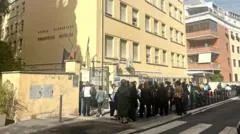
The scale of the disruption was particularly evident in Italy, where the threats prompted several precautionary evacuations. However, the alarm was quickly lifted in most locations, allowing pupils to return to their classrooms. Despite the official stance that there is no immediate danger, the psychological impact on the community remains a significant concern for local leaders.
Regional impact and response statistics
The following table summarizes the reported scale of the threats across the affected regions based on available official data:
| Region | Estimated Number of Schools Targeted | Official Status |
|---|---|---|
| Italy (State Schools) | 6,300 | Suspected hoax / Cyber-attack |
| Scotland | 700+ | Suspected hoax |
| Northern Ireland | Included in 700+ total | Remain open unless advised |
The 'Mikhail Andropov' connection and message content
The threatening messages shared similar linguistic patterns and references, suggesting a common origin despite different regional claims. In Italy, the email was attributed to a figure named "Mikhail Andropov," identified in the text as the leader of "Vilayat di Misoginistan." Conversely, the BBC observed that the version of the email sent to Scottish schools referenced the same name, Mikhail Andropov, but associated him with a "Red Owl" project rather than the group mentioned in the Italian versions.
The content of these emails has been described by some educators as highly unusual or even absurd. Massimo Nunzio Barrella, a headteacher in Milan, told Adnkronos news agency that he recognized the email as spam almost immediately upon its arrival at 08:59. He described the text as "almost comical," comparing the tone to a message from "Martians" stating, "We have come to annihilate you." Barrella noted that the nature of the text allowed him to reassure parents without necessitating a full evacuation.
Identifying the source of the messages
Law enforcement and cyber-crime specialists are currently investigating the digital footprint of these emails. In Scotland, Education Secretary Mairi McAllan confirmed that specialist cyber-crime officers are working to identify the source of the messages. While Scottish police initially assessed the warnings as hoaxes, the complexity of the cross-border targeting suggests a sophisticated digital campaign rather than isolated incidents of prank calling or individual mischief.
Governmental responses and public safety assurances
Government officials across the affected territories have prioritized public reassurance to prevent mass panic. In Italy, Prime Minister Giorgia Meloni addressed the situation on Facebook, stating that the reports appeared linked to a "strategy intended to cause alarm and concern." Similarly, in Scotland, Mairi McAllan emphasized that there was no risk to the public, while acknowledging the distress caused to parents, pupils, and school staff. In Northern Ireland, the approach was to maintain operational stability, with officials instructing schools to remain open unless directed otherwise by the police.
Local authorities have also been active in verifying the safety of specific buildings. In the Umbria region of Italy, the head of the central region, Stefania Proietti, stated that checks conducted in Umbrian schools had proved negative and that law enforcement was working to verify every report. This localized verification process is essential to distinguish between the widespread digital hoax and any potential physical threats.
Managing parental anxiety and school operations
The tension between official safety assurances and parental concern has created a challenging environment for school administrators. While Police Scotland advised that there was "no requirement to evacuate schools or keep children away from education based solely on the content of the emails," the practical reality on the ground varied. Some local authorities confirmed that evacuations did occur, and some parents chose to take their children home for the day despite the official "hoax" designation.
Broader context of European security disruptions
The school bomb threats are part of a larger pattern of disruptive activity seen across Europe in recent weeks. Last week, Italian airports and various airlines were hit by a series of bomb hoaxes that resulted in scares, evacuations, and widespread travel disruption. This pattern of targeting critical infrastructure—ranging from transportation hubs to healthcare facilities—indicates a growing trend of using digital misinformation to cause societal instability.
There has been confusion regarding the groups responsible for these disruptions. While some threats were claimed by an extremist misogynistic group, that group later denied any link to the false warnings sent to schools and other sectors. This lack of clear attribution complicates the efforts of intelligence services to determine whether the threats are the work of a specific organized entity or a decentralized group of actors using similar tactics to maximize chaos.
The role of digital literacy in threat assessment
The ability of individual educators to identify these threats as fraudulent has played a role in mitigating panic. For instance, Anna Bertato, a headteacher in Milan, reported that after checking the sender's email address online, she found it had already been classified as spam by a university student in Taiwan. Such instances of rapid, informed assessment help prevent the unnecessary escalation of what are ultimately digital hoaxes.



