
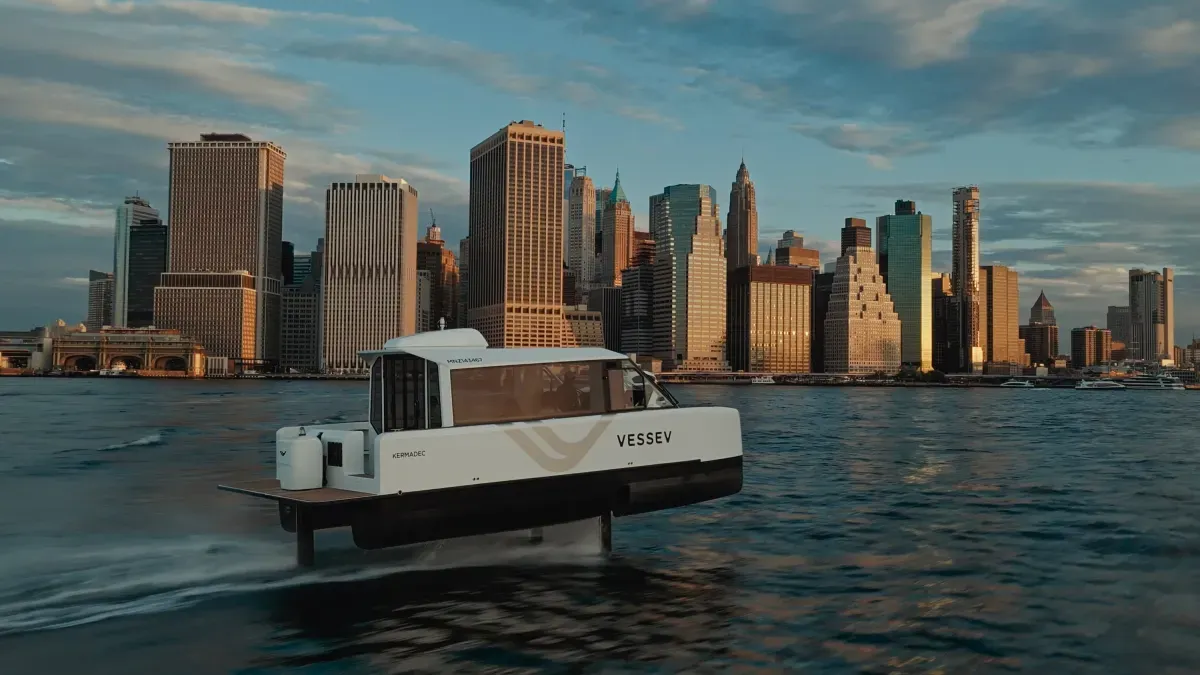
How does the Vessev VS-9 utilize hydrofoil technology?
The Vessev VS-9 operates by using underwater wing-like structures, known as foils, to lift the vessel's hull clear of the water's surface. While the boat resembles a standard catamaran at rest, its performance changes significantly once it reaches sufficient speed. At this stage, the foils generate lift, allowing the vessel to glide above the waves rather than pushing through them.
The engineering of the VS-9 relies on a specific distribution of lift to maintain stability. According to Vessev, the majority of the lifting force is generated by the front foil, while the rear foil handles approximately 20% of the load. To ensure a smooth experience for passengers, the system utilizes computer-controlled underwater flaps that constantly adjust to maintain stability and counteract the movement of the water.
Mechanical stability and lift distribution
The transition from traditional displacement sailing to hydrofoiling is a key technical milestone for the VS-9. Unlike traditional 30-foot boats that often experience significant bouncing or 'slapping' against the water as they accelerate, the VS-9 utilizes its foils to bypass this turbulence. This mechanism not only provides a smoother ride, akin to a high-performance sports car, but also significantly reduces the wake produced by the vessel, which is an essential consideration for navigating sensitive waterways and busy urban channels.
Why is hydrofoil technology critical for electric boats?
Hydrofoil technology is a primary driver of efficiency for electric vessels because it addresses the fundamental challenge of battery range. In electric marine propulsion, every kilowatt-hour of energy is vital for maximizing distance. By lifting the hull out of the water, the VS-9 drastically reduces hydrodynamic drag, which is the primary force resisting a boat's movement.
This reduction in drag allows the electric motor to operate more efficiently, extending the vessel's operational reach. Eric Laakmann, co-founder and CEO of Vessev, has emphasized that the combination of electric power and hydrofoil lifting is what makes these vessels commercially viable for longer-distance transit. The VS-9 is capable of carrying a full passenger load for up to 40 nautical miles (approximately 74 kilometers) on a single charge, making it a practical candidate for short-to-medium range maritime routes.
In-house component manufacturing
To manage costs and maintain control over the technology stack, Vessev has opted to manufacture several key components in-house. The rear foil of the VS-9 houses the electric motor, which is developed by Vessev's own engineering team. Laakmann noted that bringing production in-house early in the development cycle is a strategic move to keep long-term costs in line. The only major component the company does not produce is the battery system, which Laakmann described as a 'commoditized' technology that can be sourced externally.
What are the operational limitations of the VS-9?
Despite the efficiency gains, the VS-9 is not a universal solution for all maritime environments. The effectiveness of the hydrofoil system is highly dependent on water conditions. For the VS-9 to maintain its 'flight' and its associated efficiency, the waves must remain below a certain threshold. Specifically, the design is optimized for waters where the vessel can clear the surface by about 0.75 meters (two and a half feet).
If wave heights exceed this limit, the water begins to strike the hull directly. This contact disrupts the hydrofoil's lift, causing the boat to lose its smooth ride and increasing drag, which in turn saps the battery's energy. Consequently, while the VS-9 is highly effective in controlled environments, it is not intended for the unpredictable conditions of the open ocean. Instead, its ideal deployment zones include:
- Rivers and urban canals
- Lakes and reservoirs
- Protected bays and coastal waterways
How could Vessev impact urban mass transit?
Vessev is targeting transit operations as its primary market entry point, aiming to augment existing urban transportation networks. The goal is to provide a high-speed, low-infrastructure solution for moving people between coastal urban centers. In cities like New York, the VS-9 could theoretically connect boroughs such as Brooklyn and Queens more efficiently than traditional ferry services, without the need for massive new land-based infrastructure projects.
By reducing the cost of operating smaller vessels through electric efficiency and hydrofoil speed, Vessev hopes to make water-based transit a competitive alternative to buses or subways for specific routes. Beyond public transit, the company is also looking toward the luxury and hospitality sectors. Early demonstrations have already attracted interest from wealthy individuals and tour operators looking for high-end, innovative maritime experiences.
Future business models and scalability
Looking ahead, Vessev is considering several paths for scaling its technology. While the current VS-9 is a unique prototype, the company intends to move into broader production. One potential evolution of their business model involves the production of electric hydrofoil kits. This would allow other established boatbuilders to integrate Vessev's proprietary lifting and propulsion technology into their own vessel designs, effectively turning Vessev into a technology provider for the wider maritime industry.
FAQ: Vessev VS-9 Electric Ferry
What is the maximum range of the Vessev VS-9?
The VS-9 can travel up to 40 nautical miles (74 kilometers) while carrying a full load of passengers. This range is made possible by the efficiency of the hydrofoil system, which reduces the energy required to move the vessel through the water.
Can the VS-9 be used in the open ocean?
No, the VS-9 is not designed for open ocean travel. The hydrofoil system works best when waves are below 0.75 meters (2.5 feet). In higher waves, the hull hits the water, reducing efficiency and comfort, making it better suited for rivers, lakes, and bays.
How does the VS-9 charge its batteries?
The VS-9 is designed to be compatible with standard charging infrastructure. It can utilize a typical electric vehicle (EV) charger, which simplifies the integration of these vessels into existing electrical grids and docking facilities in urban environments.
What makes the VS-9 ride smoother than traditional boats?
The smoothness comes from the hydrofoil technology, which lifts the hull above the water. While traditional boats bounce and slap against waves, the VS-9 uses computer-controlled underwater flaps to maintain a stable, gliding motion above the surface.
Is Vessev manufacturing all parts of the ferry?
Vessev manufactures its own electric motors and foils in-house to control costs. However, they do not produce the batteries, as they view battery technology as a commoditized component that can be sourced from external suppliers.
Key takeaways
- The VS-9 uses hydrofoil technology to lift its hull, significantly reducing drag and increasing energy efficiency.
- Vessev raised $19 million in Series A funding in August 2026 to advance its electric maritime technology.
- The vessel is optimized for protected waters like rivers and bays, with a wave limit of 0.75 meters.
- The VS-9 offers a range of 40 nautical miles (74 kilometers) under a full passenger load.
The future of electric maritime mobility
Vessev's approach to electric transit represents a strategic intersection of hydrofoil aerodynamics and battery efficiency. By focusing on the specific constraints of urban waterways, the company is carving out a niche that avoids the complexities of open-ocean navigation while addressing the need for faster, cleaner transit. Whether through direct vessel sales or the future licensing of hydrofoil kits, Vessev is positioning itself as a foundational player in the transition toward sustainable, high-speed maritime mobility.




