
What is Triple-A Minesweeper and why does it exist?
Triple-A Minesweeper is a satirical experience created by developer Mike Lacher that functions as a concentrated parody of modern high-budget video game design. Rather than being a traditional puzzle game, it uses the familiar mechanics of Minesweeper to highlight the perceived absurdities of the "Triple-A" industry. The game is designed to be brief, often taking only five minutes to complete, yet it manages to condense years of industry-wide design trends into a single, cohesive joke.
The core intent of the game is to skewer the trend of excessive handholding. In recent years, many major publishers have been criticized for fearfully overcompensating for the possibility that a player might become lost or confused. Lacher’s game takes these well-meaning but often intrusive design choices and pushes them to their logical, ridiculous extremes. By doing so, it provides a mirror to the current state of blockbuster gaming, where the player's agency is frequently undermined by constant guidance.
How does the game parody industry tropes?
The satire in Triple-A Minesweeper begins before the actual gameplay even commences. While a standard game of Minesweeper allows for immediate interaction, Lacher’s version forces the player to endure a sequence of unskippable title cards representing third-party software and various developers. This mimics the lengthy, cinematic introductions that often delay the start of modern AAA titles, serving as the first layer of its critique on player pacing and autonomy.
Once the game begins, the parody shifts toward visual and auditory overstimulation. The game utilizes several specific tropes to mock the way modern titles guide players through environments:
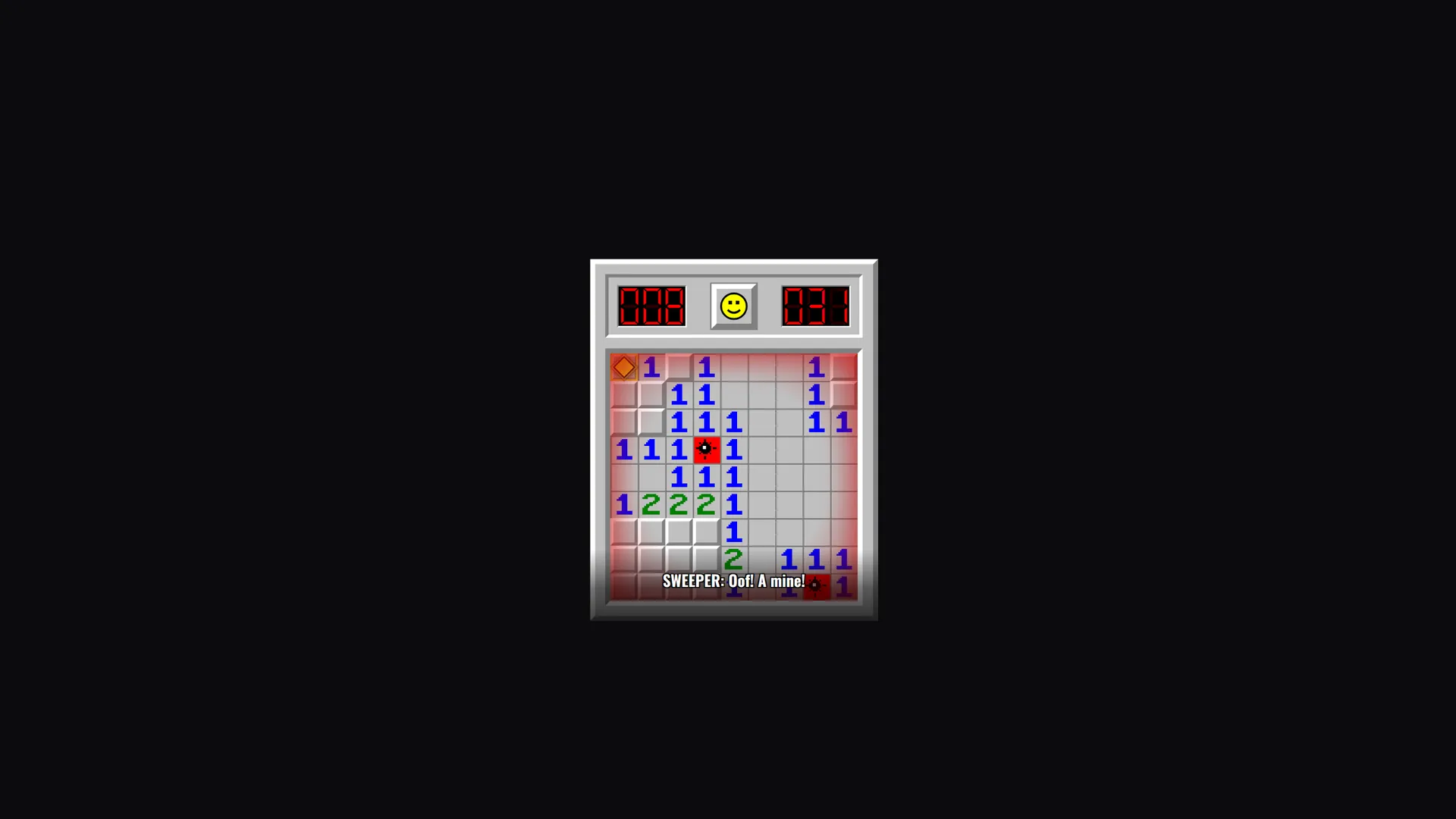
- Visual Markers: Much like the "yellow paint" used in games like Stellar Blade to highlight traversable ledges, Triple-A Minesweeper provides a prominent diamond-shaped yellow marker to tell the player exactly where to click.
- Constant Dialogue: The protagonist, known as "the Sweeper," provides a continuous stream of verbal feedback. Instead of allowing players to deduce the puzzle, the character vocalizes thoughts such as "Pretty sure there's one mine nearby," removing any sense of intellectual challenge.
- Narrative Intrusion: Characters like Nora provide immediate, unprompted context that dictates the player's every move, mirroring the way modern narratives often leave little room for player interpretation.
The impact of excessive guidance on player agency
The primary target of this parody is the erosion of player agency. When a game provides a yellow marker for every ledge or a voice in the ear for every logical deduction, the player ceases to be an active participant and becomes a passive observer of a guided sequence. This "handholding" is often implemented by developers to prevent frustration, but as Triple-A Minesweeper demonstrates, it can also result in a loss of the very satisfaction that comes from overcoming a challenge.
Why is the satire of "handholding" so relevant today?
The relevance of Triple-A Minesweeper stems from a growing debate within the gaming community regarding the balance between accessibility and difficulty. Critics often point to recent examples where the line between helpful guidance and intrusive instruction has become blurred. For instance, the heavy-handed puzzle hints provided by characters in God of War: Ragnarok have been cited as instances where the game overcompensates for player potential confusion.
Furthermore, the trend extends to gameplay automation. The source notes that recent titles, such as Marvel's Wolverine, have been criticized for portions of the experience where the game essentially plays itself. This reduction in player input is a central theme that Lacher’s satire addresses. By making the Sweeper vocalize every thought and the game continue without consequence even when a mine is hit, Lacher highlights how modern design often removes the stakes and the mental engagement required to make a game feel rewarding.
What happens when the player attempts to deviate from the path?
One of the most effective comedic elements of Triple-A Minesweeper is its reaction to player error or non-compliance. In a traditional Minesweeper game, hitting a mine results in an immediate end to the session. In Lacher's parody, hitting a mine results in nothing more than a mild exclamation from the Sweeper: "Oof, a mine!" The game continues unabated, mocking the lack of meaningful consequences in games that are designed to be impossible to fail.
Even if the player chooses to do nothing at all, the game refuses to let them be at peace. The satire escalates through a constant barrage of auditory clutter. The Sweeper will repeatedly state his objective, while various characters—ranging from a malevolent figure known as "The Don" to a local radio DJ—interject via voice communication. This relentless chatter is intended to be annoying, serving as a direct critique of the "noise" that often accompanies modern AAA productions, where narrative and character dialogue can become a distraction from the core gameplay loop.
Is there a constructive way forward for game design?
While Triple-A Minesweeper is a comedic send-up, the underlying issue it addresses is a serious one for developers. The critique is not necessarily that guidance is bad, but that it is often implemented without subtlety or invention. The intent behind these design decisions is usually well-meaning—aiming to make games more inclusive and less frustrating—but the execution often lacks the nuance required to maintain player engagement.
The challenge for the industry lies in finding more inventive ways to guide players without stripping them of their sense of discovery. Instead of bright yellow paint or constant verbal cues, developers could look toward environmental storytelling, subtle lighting, or more organic wayfinding techniques. The goal is to support the player through intuitive design rather than through explicit, intrusive instruction that treats the player as if they are incapable of navigating the world on their own.
FAQ: Triple-A Minesweeper and AAA Design
What is the main theme of Triple-A Minesweeper?
The main theme is the satire of modern Triple-A video game design, specifically focusing on the excessive handholding, intrusive UI markers, and constant character dialogue that many players find frustrating in blockbuster titles.
Who created Triple-A Minesweeper?
The game was created by developer Mike Lacher. It is a short, satirical experience designed to highlight and mock common industry trends through the familiar mechanics of the classic game Minesweeper.
What are some specific tropes the game mocks?
The game mocks several tropes, including unskippable developer logos, the use of bright yellow markers to guide players (similar to "yellow paint" in other games), and characters who constantly vocalize their thoughts and instructions to the player.
Does the game have real consequences for mistakes?
No, the game deliberately removes consequences to mock modern design. If a player hits a mine, the character simply makes a small sound and the game continues, highlighting the lack of stakes in overly-guided games.
Why is the dialogue in the game so persistent?
The persistent dialogue, including voices from characters like "The Don" and radio DJs, is intended to be intentionally annoying. This serves as a satire of how modern AAA games often use constant chatter to fill space or guide players.
Key takeaways
- Triple-A Minesweeper is a satirical indie game by Mike Lacher that parodies blockbuster gaming habits.
- The game mocks excessive handholding through features like unskippable logos and yellow guidance markers.
- It critiques the lack of consequence in modern games by allowing players to hit mines without failing.
- The satire highlights how constant character dialogue can become an intrusive distraction from gameplay.
Conclusion
Triple-A Minesweeper serves as a sharp, comedic reminder of the fine line between helpful accessibility and intrusive design. By amplifying the most egregious habits of the Triple-A industry—such as excessive guidance and constant narrative chatter—Mike Lacher provides a meaningful critique of how modern games often sacrifice player agency for the sake of avoiding frustration. While the developers' intentions are typically to make games more approachable, the satire suggests that the industry must strive for more subtle, inventive ways to support players without stripping them of the joy of discovery and the satisfaction of genuine challenge.




