
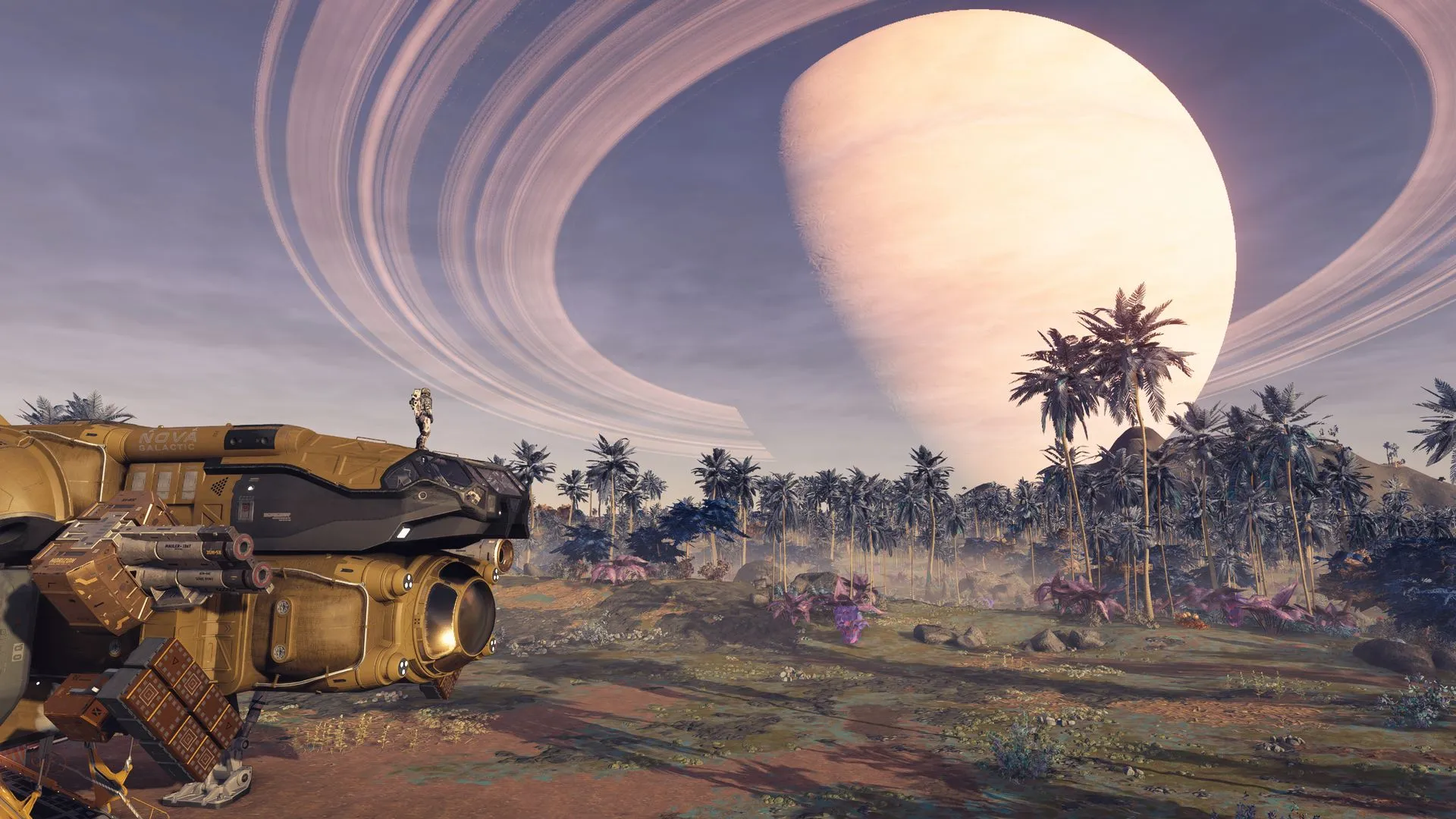
How does the Seamless Landing mod change the Starfield experience?
The Seamless Landing mod fundamentally alters the transition from orbital flight to ground-level exploration by removing the traditional loading screens and menu-based landing selections. Currently, players arriving at a planet in Starfield must select a landing site and wait for an animation and loading sequence to complete. This process creates a disconnect, making the player's spacecraft feel less like a physical vehicle and more like a stationary hub that teleports between locations.
Frederik Wessberg, the developer behind the project, has designed a system that allows for a continuous descent. The mod enables players to fly manually in low orbit or engage an autopilot while walking around the ship during the descent. This level of interactivity ensures that the transition from the vacuum of space to a planetary surface feels like a single, uninterrupted journey rather than a series of disconnected scenes.
Bridging the gap between space and surface
By removing the hard breaks in gameplay, the mod addresses one of the most significant criticisms of the original title's space exploration loop. The ability to land anywhere—including on water—provides a sense of agency and freedom that was previously restricted by the game's engine-level loading requirements. This shift moves the gameplay closer to the seamless planetary transitions seen in titles like No Man's Sky.
What technical methods are used to mask the transition?
The mod utilizes atmospheric effects and environmental visual cues to hide the technical necessity of a "cell switch" during descent. Wessberg has implemented a system where clouds and atmospheric heating effects serve as visual bridges. During atmospheric entry, the ship experiences heating effects and enters cloud layers, providing a natural visual moment of whiteout or obscured visibility.
Crucially, Wessberg clarifies that these clouds are not merely a "fancy loading screen." Instead, they are used to minimize the visual seam at the exact moment the game performs the final cell switch. This switch involves adjusting lighting, exposure, and terrain color to match the new environment. For airless moons or planets, the transition is handled without a veil, relying on exposure matching to ensure the change in lighting remains subtle and unnoticeable to the player.
Background loading and interactivity
The underlying mechanism for this transition is designed to happen entirely in the background. While the player is descending through the atmosphere, the game remains interactive. The actual asset swap only occurs once the necessary data has finished loading in the background, ensuring that the player never encounters a frozen screen or a loss of control during the most critical part of the flight.
How does the mod reimplement planet rendering?
To achieve a seamless transition, Wessberg had to completely reimplement how Starfield renders planets in space. In the base game, planets often appear as essentially flat textures that can be flown through if a player spends enough time navigating the orbital boundaries. The mod replaces these textures with actual 3D models of planets and moons that maintain high levels of detail and sharpness at every altitude.
This reimplementation is not merely a visual overlay; it is a deep integration with the existing game engine. The developer noted that he had to create a way for these 3D models to look detailed regardless of how close the player flies to the surface. This ensures that the transition from a distant celestial body to a nearby landscape is visually consistent and free of the "pop-in" effects that often plague large-scale space simulations.
Why does the mod rely on Starfield's existing physics data?
The effectiveness of the Seamless Landing mod is largely due to its ability to leverage the existing, highly accurate physical data within Starfield. Wessberg describes the game's internal data as the "truth," which he then modulates using real-world physics to enhance the realism of the 3D planet rendering.
The rendering engine for the mod is built upon several specific data sets provided by the game, including:
- Biome and Surface Maps: Ensuring the 3D models match the actual terrain of the planet.
- Atmospheric Composition: Influencing how light interacts with the atmosphere during descent.
- Climate Data: Helping to dictate the visual characteristics of the planetary surface.
- Orbital Mechanics: Accounting for the planet's position, distance from the sun, and the influence of nearby moons on moonlight and lighting.
By using this data, the mod ensures that the simulated planets behave according to the same rules as the rest of the game world, providing a sense of continuity that feels earned rather than artificial.
Where can players access the Seamless Landing mod?
The completed version of the Seamless Landing mod is intended to be freely available to the community via Nexus Mods. This accessibility ensures that the vast majority of the Starfield player base can benefit from the improved immersion and technical refinements provided by Wessberg's work.
While the mod will be hosted on Nexus Mods for general use, further technical details and development updates have been shared via the developer's Patreon. The project represents a significant community-driven effort to refine the core loop of space exploration, turning a segmented experience into a more cohesive and physically grounded simulation.
Frequently asked questions
Does the mod add a loading screen during descent?
No, the mod is designed to eliminate traditional loading screens. Instead, it uses background loading processes that occur while the player remains in control of the ship. Atmospheric effects like clouds and heating are used to visually smooth the transition during the technical cell switch.
Can you land on water with this mod?
Yes, one of the key features of the Seamless Landing mod is the ability to land anywhere on a planet's surface, including on bodies of water. This removes the previous limitations that required players to select specific, pre-determined landing zones provided by the game.
Is the mod's planet rendering just a visual texture?
No, the mod replaces the game's orbital textures with actual 3D models. These models are designed to remain sharp and detailed at all altitudes, providing a much more realistic sense of scale and depth than the original texture-based approach.
Does the mod use the game's original data?
Yes, the mod relies heavily on Starfield's existing biome, climate, and atmospheric data. It uses this "truth" as a foundation and then applies real-world physics to modulate the rendering, ensuring the new 3D models are consistent with the game's internal logic.
Where will the mod be officially released?
The finished version of the mod will be released for free on Nexus Mods. This allows the community to download and install the mod easily, enhancing the overall space exploration experience for Starfield players.
Key takeaways
- The Seamless Landing mod removes loading screens and manual landing site selection during planetary descent.
- Frederik Wessberg uses background loading to keep the game interactive during the transition.
- Atmospheric effects and cloud cover are used to mask the technical cell switch.
- The mod replaces 2D orbital textures with detailed 3D planet and moon models.
- Planet rendering is driven by Starfield's existing biome, climate, and atmospheric data.
The future of Starfield immersion
The Seamless Landing mod represents a significant leap in how players interact with the universe of Starfield. By bridging the gap between orbital space and planetary surfaces, it transforms the experience from a series of menu-driven transitions into a continuous, physical journey. The technical sophistication required to reimplement planet rendering using the game's internal data demonstrates the power of the modding community to refine and expand the scope of modern RPGs. As these tools become more widely available on platforms like Nexus Mods, the line between scripted sequences and true simulation continues to blur.




