
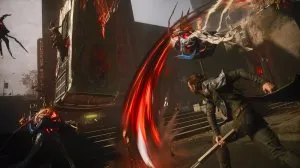
What is the Hiss Transporter in Control Resonant?
The Hiss Transporter is a recurring miniboss characterized by its terrifying fusion of urban machinery and demonic imagery. It manifests as the front end of a city bus, floating vertically and emitting a menacing red glow while its hull shakes erratically. This entity is not merely a visual anomaly; it serves as a high-threat combat encounter that requires tactical precision to defeat. The sight of a familiar piece of public infrastructure transformed into a vertical, glowing, vibrating mass of metal is enough to unsettle any player.
Combat against the Transporter involves managing multiple threats simultaneously. The bus spawns waves of 'Hiss Passengers'—enemies that appear to be horrifically fused with bus seats and crammed halfway through the windows. These passengers are not just visual flavor; they are active combatants that must be dealt with. To defeat the miniboss, players must first dispose of the Passengers exposed on the sides of the vehicle before they can execute the Transporter itself, which typically ends in a violent and fulfilling explosion. The encounter is punctuated by the sound of a loud, distorted horn and the use of ground-slam attacks that create damaging shockwaves, making the fight a significant mechanical and psychological challenge.
The Mechanics of the Encounter
The difficulty of the Hiss Transporter lies in its ability to overwhelm the player's senses and positioning. The combination of the distorted horn, the visual chaos of the shaking hull, and the constant influx of fused passengers creates a high-pressure environment. The horn acts as an omen of inevitable disaster, signaling the bus's movement and its intent to strike. When the Transporter slams into the ground, it produces shockwaves that demand immediate reaction, forcing players into a constant state of movement.
This design forces players to balance offense and defense. You cannot simply focus on the bus; you must manage the swarm of passengers that emerge from its windows. The fight becomes a rhythmic struggle of clearing the perimeter of the vehicle to prepare for the final blow. This mechanical loop ensures that the encounter is not just a slog, but a high-stakes battle against a creature that utilizes the very weight and scale of its former identity to crush the player.
How does Remedy use Altered Items and Objects of Power?
Remedy Entertainment has built a narrative and mechanical foundation based on the concept of ordinary objects imbued with extraordinary, often dangerous, properties. In the original Control, these were established as Altered Items and Objects of Power. This design philosophy suggests that the world is filled with mundane things that can become conduits for chaos or power if they are sufficiently influenced by supernatural forces. It is a way of suggesting that the extraordinary is hidden just beneath the surface of the everyday.
Several key examples illustrate this technique across the studio's history, showing how much weight a simple object can carry in their storytelling:
- The Clicker: An ordinary light switch from the Alan Wake series that becomes an all-important, vital narrative element.
- The Refrigerator: A side quest item in Control involving an agent who must maintain constant visual contact with a fridge to prevent it from becoming dangerous when unobserved.
- The Floppy Disk: A seemingly normal storage medium that becomes corrupted by the Hiss, leaving a trail of death before being pacified. Remedy notably drew inspiration from the real-life utility of floppy disks to operate nuclear missiles to give these items a sense of terrifying potential.
- The Slide Projector: A device central to the backstory of Jesse and Dylan Faden that can open doorways to other dimensions, an ability that often foments chaos and havoc.
In Control Resonant, while the focus on specific artifacts may differ from its predecessor, the core principle remains. The streets of Manhattan are populated by repurposed familiar items used for hostile purposes. A prime example is the game's first boss, the Artist Resonant, who is surrounded by street signs and chunks of concrete while utilizing stoplight poles as elegant, lethal battering weapons.
Why is the 'New Weird' effective in horror design?
The effectiveness of Remedy's approach stems from the 'new weird' genre, which thrives on the subversion of the familiar. By taking recognizable, everyday objects and altering their appearance, behavior, or function, developers can push these items into 'uncanny' territory. This creates a specific type of psychological discomfort: the realization that the environment the player knows and trusts is no longer predictable. Your familiarity is challenged, and you are confronted by the discomfort of seeing what you know behaving in ways you cannot comprehend.
When a city bus—an object typically associated with reliable public transit and the relief of arriving at a stop—is transformed into a screaming, fleshy monstrosity, it triggers primal responses. The Hiss Transporter evokes claustrophobia through its fused passengers and a sense of inevitable disaster through its lethal, metallic weight. The imagery of people stuffed through windows incites a feeling of panic that mirrors the discomfort of an overcrowded bus, but amplified to a supernatural degree. This technique turns the mundane into a source of constant vigilance and dread, making the urban landscape of Manhattan feel fundamentally unsafe.
What is the connection between Remedy and Lynchian aesthetics?
The aesthetic and tonal direction of Remedy's work, particularly under creative director Sam Lake, is heavily influenced by the surrealism of the late David Lynch. Remedy has made it no secret that Lynch is a major inspiration, and this is evident in the aesthetics, tone, and themes of both Alan Wake and Control. Lynch is renowned for his ability to juxtapose the mundane with dark, dreamlike imagery, a style often described as 'Lynchian.'
Lynch's work often employs specific motifs to achieve this effect, using common household items to signify malevolence or to create an unsettling atmosphere. Examples include:
- The Radiator in Eraserhead: Which contains a miniature, dreamlike world.
- The Ceiling Fan in Twin Peaks: Which can signify the presence of a malevolent entity.
- Electricity: A recurring motif that Lynch described as being both beautiful and dangerous, possessing a certain magical yet intangible quality. He noted that while electricity runs much of our world, its power carries a degree of ambiguity and fear.
Remedy adopts this fascination with the hidden forces within the innocuous. Just as Lynch uses electricity as a bridge between the known and the unknown, Remedy uses Objects of Power to suggest that even a floppy disk can hold the power to facilitate destruction. By uncovering the forces within things that appear innocuous, Remedy creates a world where the familiar is constantly being turned on its head, much like the unsettling streets of Manhattan in Control Resonant.
FAQ: Control Resonant and Horror Design
What makes the Hiss Transporter so frightening?
The Hiss Transporter is frightening because it subverts a symbol of public safety—the city bus—into a demonic entity. The imagery of passengers fused into seats creates claustrophobia, while its heavy, metallic movements and distorted horn transform a familiar object into a source of unpredictable terror.
How does Remedy Entertainment define Objects of Power?
Objects of Power are ordinary, everyday items that have been imbued with special and often dangerous properties. This concept allows the developers to turn mundane elements of the environment into significant narrative tools or formidable obstacles within the game's supernatural setting.
What is the influence of David Lynch on Control Resonant?
David Lynch serves as a major inspiration for the game's tone and aesthetics. His 'Lynchian' style of juxtaposing the mundane with dark surrealism is reflected in how Remedy uses common objects to create an unsettling, dreamlike, and often terrifying atmosphere.
Can you explain the 'new weird' genre in this context?
The 'new weird' is a genre that utilizes the uncanny by altering the behavior and appearance of recognizable objects. In Control Resonant, this is achieved by taking familiar urban elements and recontextualizing them into something sinister, challenging the player's sense of reality.
What are some examples of Altered Items in the series?
Examples include the light switch in Alan Wake, a refrigerator that requires constant observation, and a slide projector that can open dimensional rifts. These items demonstrate how the studio turns the ordinary into something fantastical or hazardous.
Key takeaways
- The Hiss Transporter is a miniboss that transforms a city bus into a terrifying, vertical demonic entity.
- Remedy uses 'Altered Items' to turn mundane objects like floppy disks and light switches into powerful narrative tools.
- The game's horror relies on 'new weird' principles, creating dread by subverting familiar urban environments.
- David Lynch's surrealist style heavily influences the game's ability to blend the ordinary with the sinister.
The power of the ordinary
The design philosophy of Control Resonant proves that true horror does not always require the creation of entirely new monsters. Instead, the most profound dread often comes from the distortion of what we already know. By weaponizing the mundane—turning buses into predators and street signs into blades—Remedy Entertainment forces players to confront the instability of their own reality. This mastery of the uncanny ensures that the environment itself becomes a character, one that is as unpredictable and dangerous as any traditional antagonist.




