Does Gears of War: E-Day offer new narrative depth?
Gears of War: E-Day fails to provide the transformative storytelling typically found in great prequels like Red Dead Redemption 2 or Halo: Reach. While those titles recontextualize their predecessors by adding emotional weight to established characters, E-Day largely treads familiar ground without offering significant surprises for longtime fans.
The plot follows Marcus Fenix and Dominic Santiago during the catastrophic E-Day event, yet the characterizations remain largely static. Marcus retains his signature gruff, no-nonsense attitude, and Dom remains preoccupied with the fate of his wife, Maria. The relationship between the two protagonists, while central to the series, is not explored with enough depth to add new meaning to their bond. Even iconic elements, such as the origin of the Mark 2 Lancer, are handled with a lack of narrative weight, often occurring off-screen or through brief, throwaway encounters.
The game appears to target newcomers more than veterans. It frequently treats established concepts—such as the mechanics of Emergence Holes or the presence of long-standing enemies like Boomers and Reavers—as if they were novel revelations. This approach suggests a missed opportunity to engage the existing fanbase with deeper lore or unexpected twists.
A story for newcomers rather than veterans
By treating known quantities as new discoveries, the game creates a disconnect with players who have spent decades in the Gears universe. Instead of deepening the lore, the narrative often feels like a boilerplate setup for future content, leaving many questions unanswered and failing to address previous series cliffhangers.
How has the combat evolved in this entry?
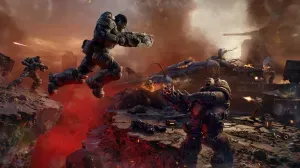
Combat remains the undisputed strength of Gears of War: E-Day, offering a highly polished and visceral experience that builds upon the series' foundation. The signature "crunchy" feel of the weaponry and the brutal physics of the Locust enemies ensure that the moment-to-moment action is as satisfying as ever.
Several key mechanical improvements have been introduced to modernize the gameplay loop:
- Weapon Customization: Players can now equip weapon mods to alter gun behavior, adding scopes, laser sights, or specialized bayonets.
- Enhanced Perfect Reloads: The classic mechanic has been expanded, allowing players to gain specific benefits like increased fire rates or incendiary ammunition through timed reloads.
- Increased Agility: Characters are more mobile than in previous installments, capable of sliding, jumping, and mantling cover with greater fluidity.
- Verticality: Level design has embraced a more vertical approach, though the core experience remains firmly rooted in cover-based tactics.
Despite these additions, the fundamental loop of popping out from cover to take shots or flanking enemies remains unchanged from the 2006 original. The game succeeds in making the action feel more spectacular, but it does not fundamentally reinvent the genre.
What is the experience of exploring Kalona?
The game is set in and around the city of Kalona, which features a visually striking blend of classical European architecture and modern industrial gothic styles. The environment serves as a backdrop for both linear, cinematic missions and more open-ended exploration.
The open sections of the game allow players to traverse city blocks, encounter side missions, and collect items. However, these segments often struggle to maintain the frenetic pace established by the combat. Many side missions rely on repetitive wave-survival tasks, and the urban environments frequently utilize similar layouts, which can diminish the sense of discovery.
One of the more effective uses of the environment is the depiction of the city's destruction. Players can witness the same locations at different stages of the invasion, seeing streets transformed into massive sinkholes and ruins. This visual progression provides a sense of the Locust's overwhelming power, even if the exploration itself lacks variety.
The tension between linearity and openness
While the open areas provide visual scale, the linear missions are generally considered superior. The linear segments lean into the high-spectacle, cinematic action that defines the series, providing a tighter and more focused experience than the occasionally duller exploration segments.
How does the multiplayer stand up?
The multiplayer offering in E-Day is decidedly uneven, split between a traditional Versus mode and a more modern Horde Siege mode. While both have merits, they cater to different player expectations and suffer from different technical limitations.
The Versus mode adheres to an old-school, 4v4 competitive format. It avoids modern distractions like battle passes in favor of a pure, gore-filled combat experience. However, the mode feels barebones at launch, featuring only six maps and lacking essential features like a server browser, private lobbies, or skill-based matchmaking. This often leads to unbalanced matches where veteran players face off against beginners. Furthermore, the meta remains heavily dominated by close-quarters Gnasher duels, which can overshadow the tactical positioning the game attempts to encourage.
In contrast, the Horde Siege mode provides a much more dynamic and engaging experience. This mode pits three teams of four against the Locust across sprawling maps. Key features include:
- Objective-Driven Gameplay: Teams must protect specific targets, defuse explosives, or clear landing zones to succeed.
- Class-Based Progression: Players can choose from four distinct classes, such as snipers or breachers, and customize their loadouts as they level up.
- Persistent Battlegrounds: The mode allows for organic interactions, such as utilizing fortifications left behind by other squads.
While Horde Siege shows significant promise and offers a modern progression system, the overall multiplayer package remains a mixed bag of classic thrills and missing modern conveniences.
Frequently asked questions
Is Gears of War: E-Day a direct sequel to the original games?
No, E-Day is a prequel set 14 years before the events of the first Gears of War game. It focuses on the initial Locust invasion and the early experiences of Marcus Fenix and Dominic Santiago during the onset of the war.
Does the game feature open-world elements?
The game features semi-open areas within the city of Kalona, allowing for some exploration and side missions. However, it is not a full open-world game; it alternates between these explorable sections and more traditional, linear combat missions.
What is the new Horde Siege mode?
Horde Siege is a cooperative multiplayer mode where three teams of four players fight against the Locust on different fronts. It includes class-based progression, customizable loadouts, and various objectives that players must complete to survive the onslaught.
Can I customize my weapons in E-Day?
Yes, the game introduces a weapon mod system. Players can find and equip mods to change how firearms behave, such as adding scopes, laser sights, or altering the effects of perfect reloads to include incendiary ammunition.
How does the movement feel compared to previous games?
Characters in E-Day are more agile than in previous entries. The game introduces mechanics like sliding, jumping, and more fluid mantling, which contributes to a greater sense of verticality in the level design.
Key takeaways
- Gears of War: E-Day provides highly polished, visceral combat with new weapon customization and improved character agility.
- The narrative functions as a standard prequel that lacks the deep recontextualization found in other major series prequels.
- The Horde Siege mode offers a dynamic, class-based cooperative experience that stands out from the traditional Versus mode.
- Exploration in the city of Kalona is visually impressive but can occasionally disrupt the game's combat-driven pacing.
The verdict on E-Day's legacy
Gears of War: E-Day is a game that succeeds in its execution of the established formula while failing to expand its boundaries. The combat remains top-tier, and the new Horde Siege mode provides a compelling reason for fans to return to the franchise. However, the narrative's inability to provide new insights into its legendary characters prevents it from reaching greatness. It is a solid, high-quality experience that honors the past without truly evolving it, serving as a polished reminder of why the series was iconic in the first place.