
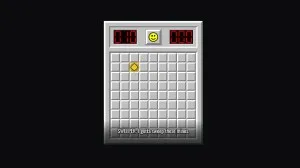
The mechanics of the AAA Minesweeper game parody
The core gameplay of the Triple-A Minesweeper remains remarkably faithful to the original logic-based puzzle. Despite the grandiose branding, the actual experience of clearing cells and avoiding mines is almost identical to the classic version players have known for decades. The humor lies not in the difficulty of the puzzles, but in the jarring contrast between the simple interface and the excessive technical presentation.
Lacher utilizes intentionally pretentious title cards to mimic the high-production values of modern blockbusters. The game falsely touts the involvement of industry giants such as Unreal Engine, Nvidia, Bink Video, and Wwise. This layer of artificial complexity serves to mock the way modern developers often prioritize technical specifications and engine marketing over fundamental gameplay loops. While the player focuses on the grid, the game surrounds them with the aesthetic of a multi-million dollar production.
A clash of simplicity and spectacle
The tension between the minimalist mechanics and the maximalist presentation is the project's primary engine. It highlights a growing trend in the industry where even the simplest concepts are wrapped in layers of cinematic fluff to justify their "Triple-A" status.
Narrative tropes and character satire
The narrative structure of the parody draws heavily from established open-world and cinematic action franchises. Mike Lacher has cited inspirations including Grand Theft Auto 5, Metal Gear Solid, and Cyberpunk 2077 to shape the game's absurd atmosphere. Instead of a quiet puzzle experience, the player is subjected to a constant stream of dramatic interruptions that serve no functional purpose in the game's logic.
The protagonist, referred to simply as "Sweeper," acts as a hollow vessel for these tropes. He remains trapped in a loop of repetitive dialogue, such as "I gotta sweep these mines," regardless of the external drama unfolding around him. This lack of character agency is a deliberate jab at how some modern protagonists feel disconnected from the high-stakes worlds they inhabit. The character's refusal to acknowledge the chaos around him emphasizes the absurdity of the situation.
The cast of callers
The parody introduces a variety of characters designed to mimic modern gaming archetypes:
- Nora: A character positioned as a potential love interest to satisfy romantic subplot requirements.
- The Don: An underworld figure who calls Sweeper to his club, hinting at a dark, mysterious past in Singapore.
- DJ Dan: A chipper announcer who celebrates Sweeper’s progress on behalf of the fictional New Dawn City.
Critiquing the modern gaming industry
Beyond the immediate laughs, the AAA Minesweeper game functions as a critique of how legacy intellectual properties are handled in the current market. While Microsoft has not fundamentally redesigned Minesweeper, they have integrated it into modern ecosystems like Microsoft Teams and even released themed merchandise, such as an "ugly" Christmas sweater. This reflects a trend of treating classic titles as brand assets rather than evolving them as games.
The parody concludes with a predictable twist ending, mirroring the often formulaic nature of high-budget storytelling. By making the outcome easy to guess, Lacher mocks the scripted, predictable narratives that frequently accompany massive gaming budgets. The game leaves the player with a sense of the emptiness that can occur when production value outpaces creative innovation. It serves as a reminder that while technical advancements are impressive, they cannot replace the soul of a well-designed game.




